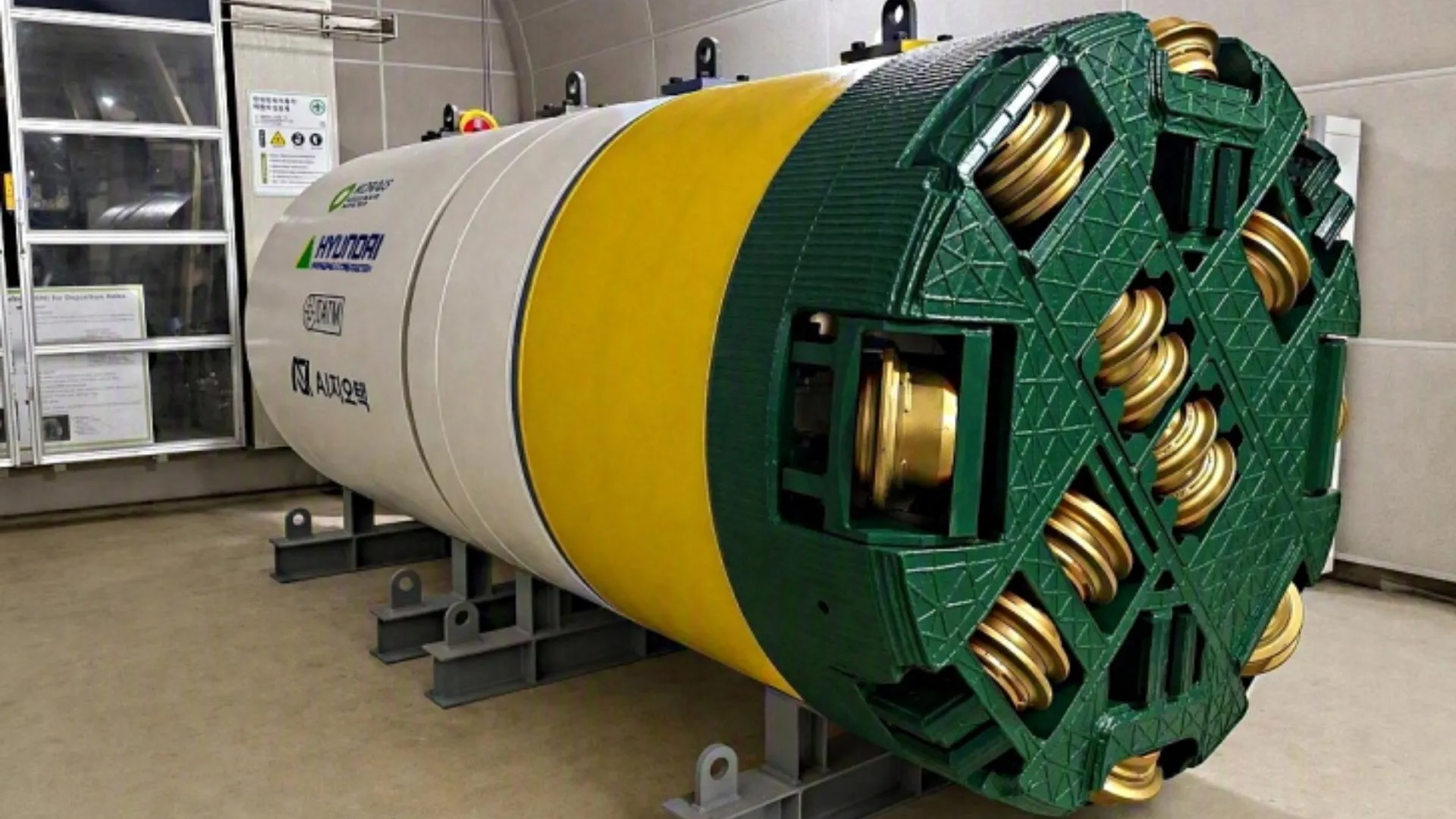
South Korea’s Hyundai Engineering & Construction has excavated a full-scale hole for used nuclear fuel disposal in bedrock, testing equipment designed to be retrieved and reused across multiple excavations.
The demonstration took place in an underground research tunnel at the company’s research site, as part of a government-funded project led by the Korea Radioactive Waste Agency (KORAD).
Hyundai E&C used real-time AI analysis to guide excavation and LiDAR mapping to check the completed hole.
The work supports the development of construction technologies for underground disposal facilities as South Korea’s existing nuclear plant storage sites approach capacity.
The equipment measures about 5.7 feet in diameter and 18.7 feet long. Hyundai E&C developed it to meet deposition hole specifications and construction conditions for the Korea Advanced Disposal System, known as KORADIS.
That system is tailored to South Korea’s geological environment and technical requirements. Deposition holes form part of the infrastructure needed to place used nuclear fuel underground.
After excavation, the cutting assembly folds inward, allowing the machine to be safely removed and used again. This addresses the need to excavate multiple deposition holes repeatedly within a disposal facility.
“This achievement is particularly significant because Hyundai E&C has become the first Korean builder to develop dedicated deposition hole excavation equipment and verify its performance and constructability through actual rock excavation,” an official from the HMG Construction Technology Research Institute said.
During the demonstration, AI analyzed excavation data in real time to assess ground conditions. The findings supported adjustments to excavation based on the rock assessment and equipment performance.
Source link