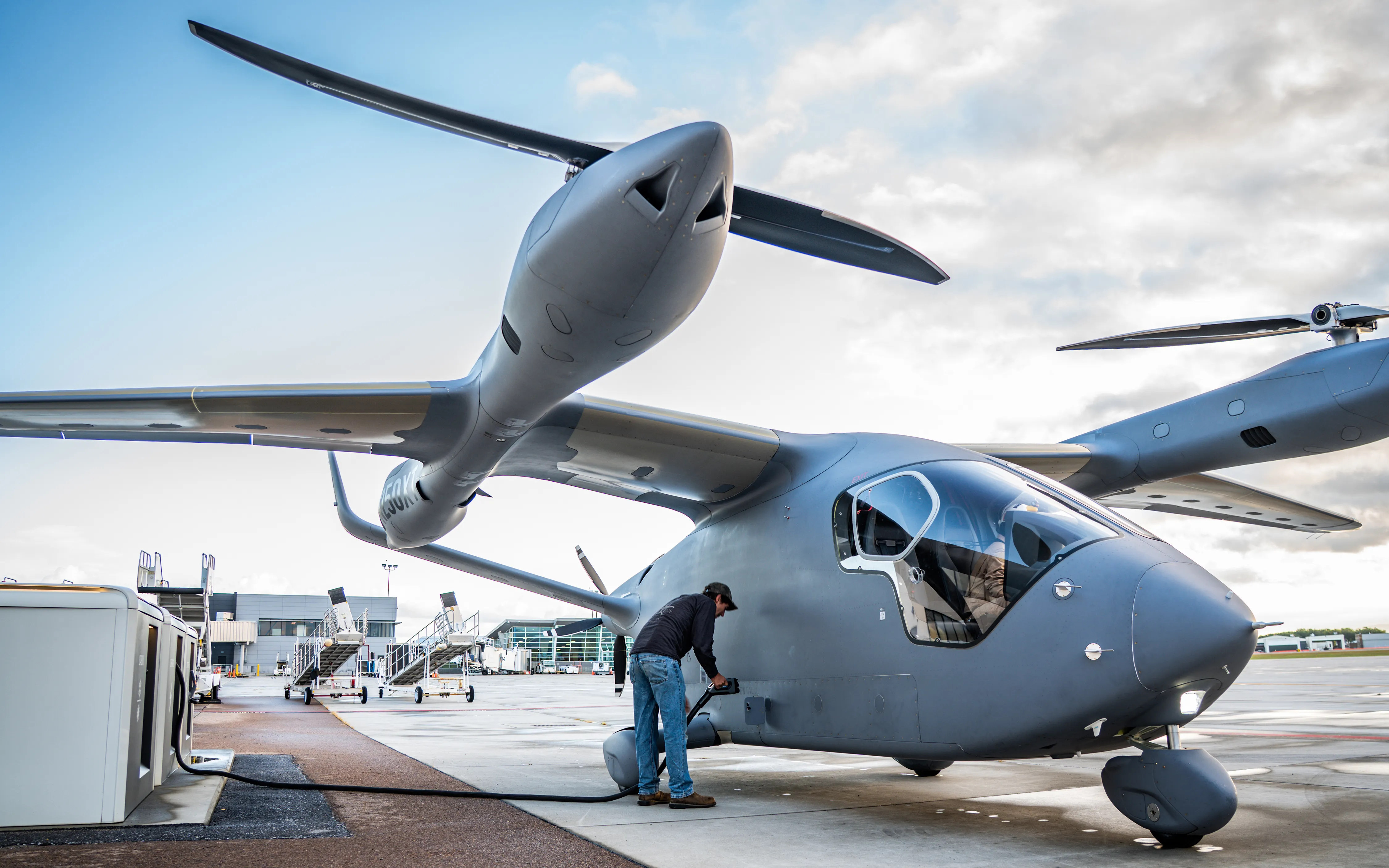
In the cockpit of Beta Technologies’ Alia CX300, pilot Chris Caputo steers onto Runway 33 at Patrick Leahy Burlington International Airport in Vermont. Cleared for takeoff, he releases the brakes and nudges the throttle forward.
At the back of the aircraft, the five-blade pusher propeller snaps awake, and the Alia bolts forward. There’s no shriek of a turbofan spooling up, no shudder of a piston engine, and no wait for thrust. Just the low hum of an electric motor and a shove of instant acceleration.
Within a few seconds, we’re at 85 knots (almost 160 kilometers per hour), and Caputo rotates the nose upward. The runway drops abruptly away as we climb. Gaining speed and altitude, we head northwest over Lake Champlain. Through the wraparound canopy, I watch the hunched shoulders of Vermont’s Green Mountains shrink under the right wing, with New York’s taller Adirondacks to the left.
Caputo, a former Air Force fighter pilot, flicks the control stick hard left, then right. Despite its 15-meter wingspan, the Alia feels snappy, its fly-by-wire system automatically coordinating aileron and rudder inputs. The machine, he says, is much simpler to manage than the Cessna 182 I flew around Australia in my student-pilot days.
What’s more, our half-hour flight in the Alia will consume only about US $9 worth of electricity. The same flight in a comparable Cessna 208 Caravan would burn roughly 25 to 30 gallons of Jet A fuel, costing about $210 to $255 at press time. “Even at full throttle, we’re not burning any fuel up here,” says Caputo, as he takes the Alia into a sweeping left turn and heads south over the lake.
Source link