
A quiet tug-of-war is playing out in nearly every enterprise today. On one hand, engineers, financial analysts, legal teams, and operations staff are turning to generative and agentic AI to debug code, summarize contracts, and automate tasks and decision-making. On the other side, security and compliance leaders are racing to prevent proprietary source code, financial projections, and regulated customer records from leaking into unauthorized models.
For most Chief Information Security Officers (CISOs), the question is no longer whether employees are using AI; it is what they are pasting into it. Yet the security tools most organizations rely on to police this boundary were built for a completely different era.
Traditional Data Loss Prevention (DLP) systems were designed for structured data moving across predictable channels such as emails, file transfers, and cloud storage. They rely heavily on regular expressions (regex), keyword lists, and static rules. If a document contains a 16-digit credit card number or a government ID, legacy DLP flags it.
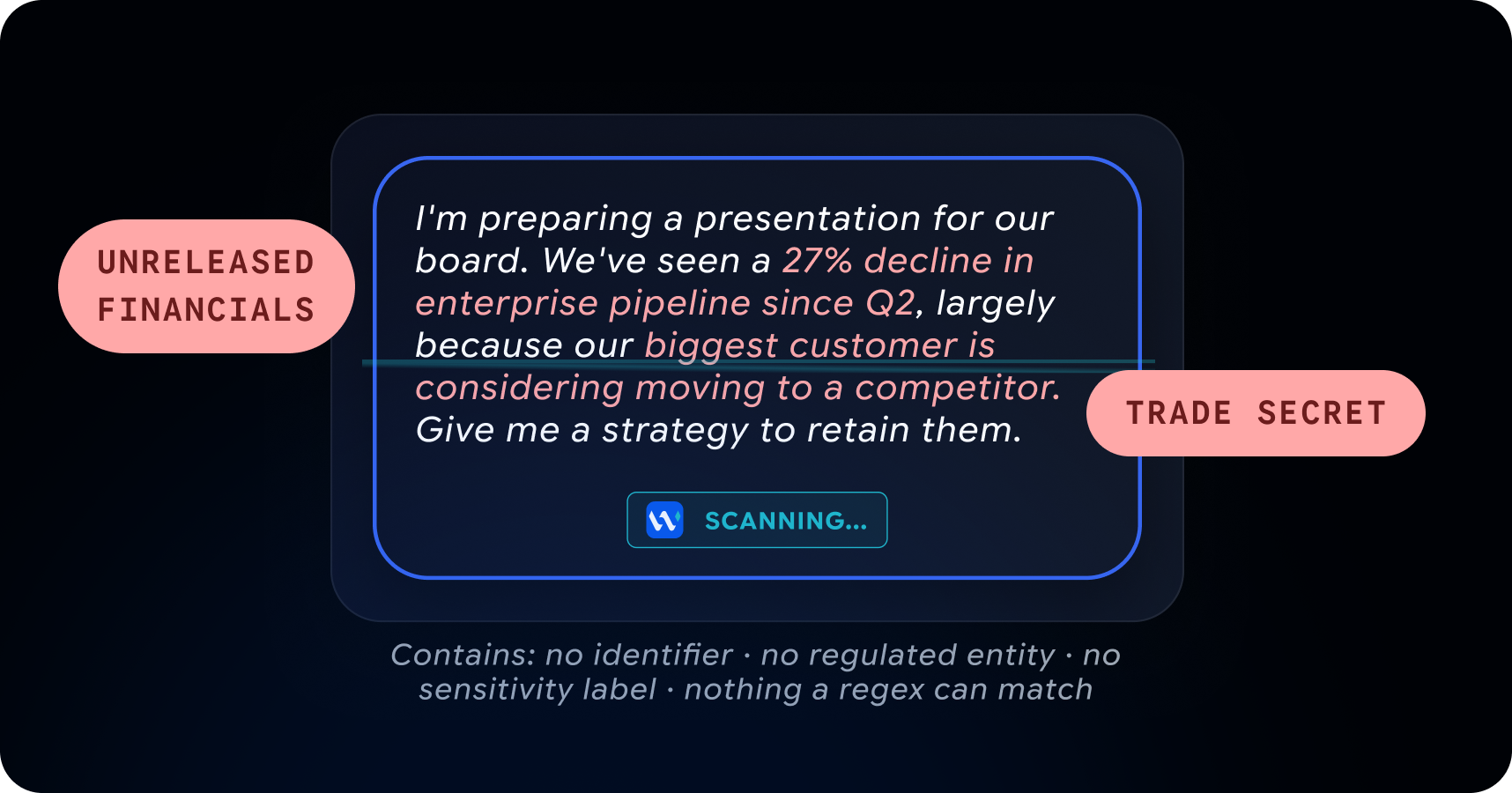
Generative AI breaks this model entirely. AI interactions happen in unstructured natural language, where data sensitivity is defined by context and intent rather than fixed formatting. Consider two scenarios:
Neither prompt contains a credit card number, a Social Security number, or a flagged keyword. To a regex-based DLP system, both interactions look completely benign. Conversely, when security teams tighten keyword rules to catch more nuances, false positives skyrocket, triggering alert fatigue for security teams and frustrating employees who are simply trying to do their jobs.
Faced with this visibility gap, many organizations initially defaulted to blunt-force bans on public AI tools.
Source link





