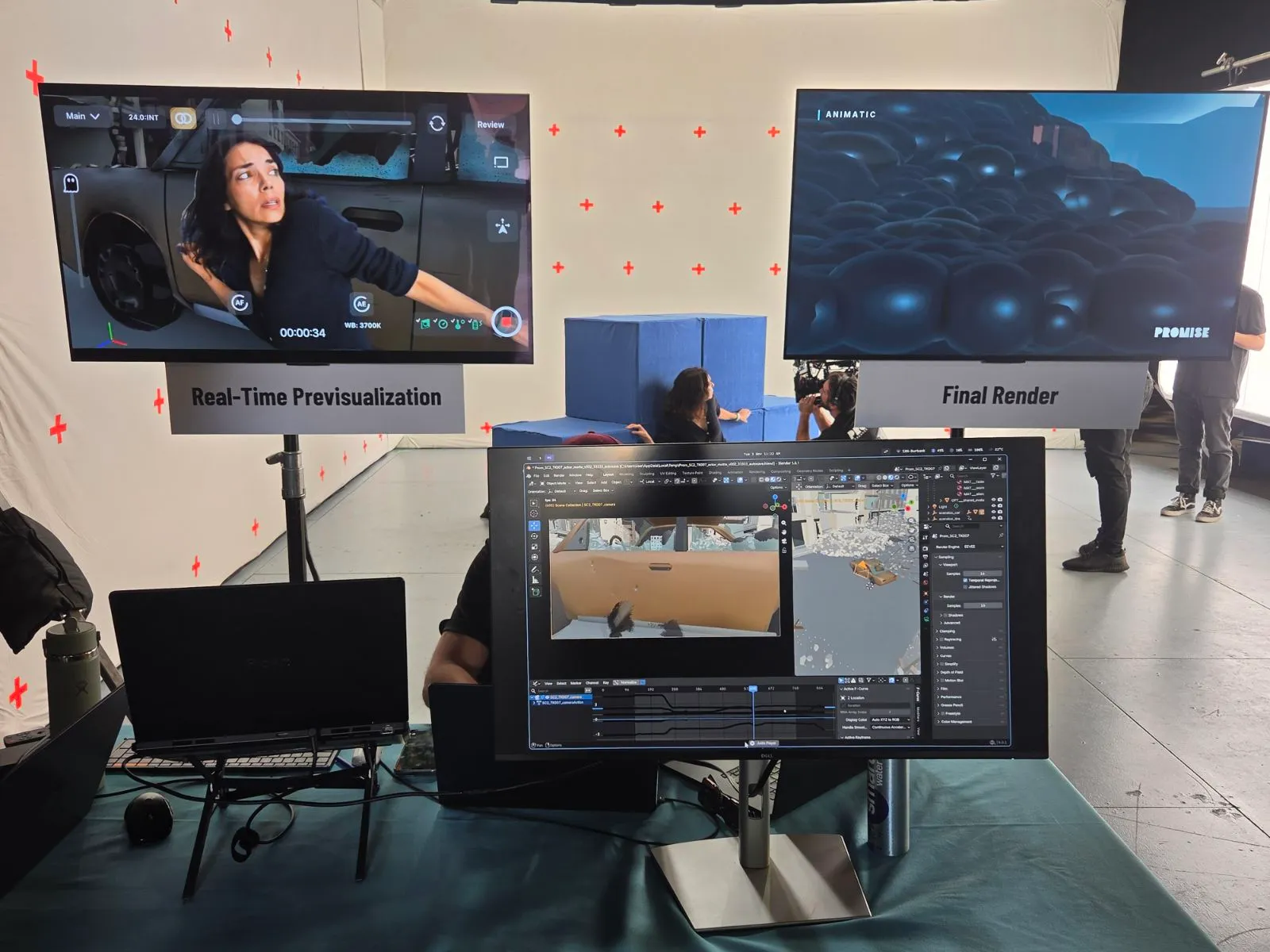
A movie set with blank, neutral walls can be filled in with AI-generated backgrounds and lighting.
On screen, a woman runs toward a cliff and peers anxiously over the edge, teetering as she looks down at a perilous mountain dotted with boulders, her hair flying in the wind.
She’s not, though. I can see her from where I’m standing in the middle of a Disney sound stage in Los Angeles. She’s standing in a “gray box,” a small, walled-off space on the studio floor, neutral-colored walls speckled with small cross marks for positioning. She’s next to a stack of blue-carpeted boxes that serve as a stand-in for whatever large prop that post-production decides to add in digitally later.
A camera is pointing at her, following her every move. And an almost instant rendering on a screen has placed her on that cliff, perfectly lit, wind tousling her hair, thanks in part to AI.
Green screens and blue screens have been used for more than half a century in TV and filmmaking, allowing post-production crews to insert visual effects and backgrounds behind the actors. But the bright hue can reflect onto objects and skin, and constant adjustments to the backdrop are needed when the director wants to switch to a new angle of the shot.
Filming in a gray box like the one I’m standing next to offers more flexible shots. And combining that with AI-generated or assisted backgrounds speeds up post-production, according to entertainment studio Promise Advanced Imagination , which showcased its filming product during the Disney Accelerator Demo Day last week.
Source link