
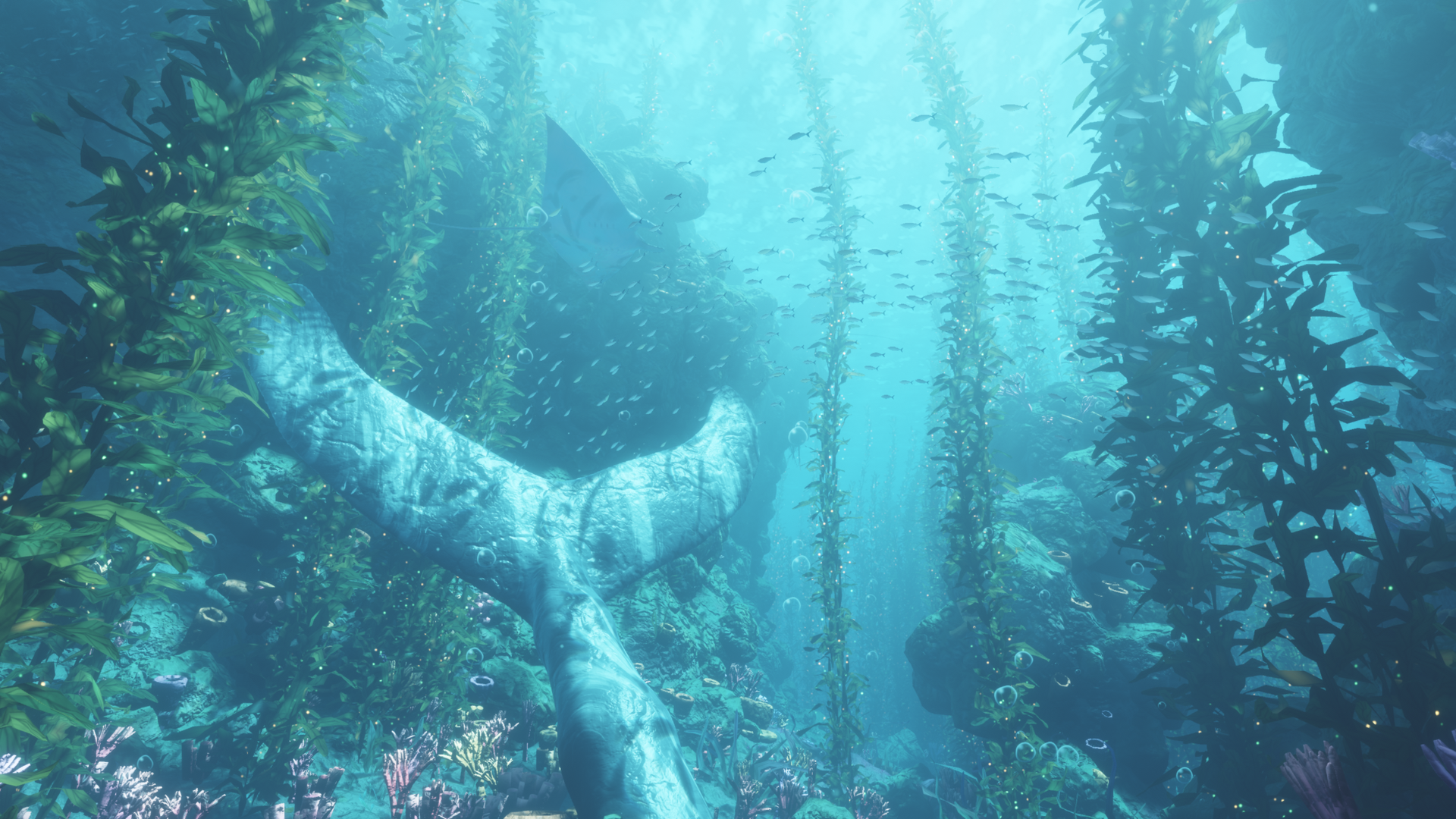
Claude Fable 5.2 was released recently to mostly rave reviews, with both users and analysis outlets ranking it nipping at the heels of the much pricier Opus 5.5. Perhaps as practical proof of that claim, front-end developer Maksymilian Dendura took inspiration from the demoscene and had Fable roll his own virtual underwater world, Abyssal Garden, in only 96 KB of Javascript/HTML — you can check it out here.
The demo's 3D space and textures are all procedurally generated, meaning they're the result of mathematical equations rather than prebuilt 3D meshes, and all calculated on load. Using actual meshes and images for textures would otherwise take up a significant amount of space.
Building structures procedurally is difficult and has limitations, but it's exceedingly effective when used properly. Some games employ this technique for repeated elements like trees and grass.
Likewise, all the visual effects and even some texturing are done with shaders, which are small programs that change how a mesh or texture appears — for example, to make parts of an object shiny. Games use them extensively, as many players are aware, thanks to endless "loading shaders" screens or Unreal Engine's st-tu-tutering.
The result is definitely impressive, especially but not only as it's purely browser-based, relying on WebGPU and WebGL. Both are rarely-mentioned technologies that have actually existed for a long while now . As their names imply, they let developers render 2D and 3D graphics in a manner similar to that of OpenGL, but in a browser, using JavaScript as the base language.
Source link





