
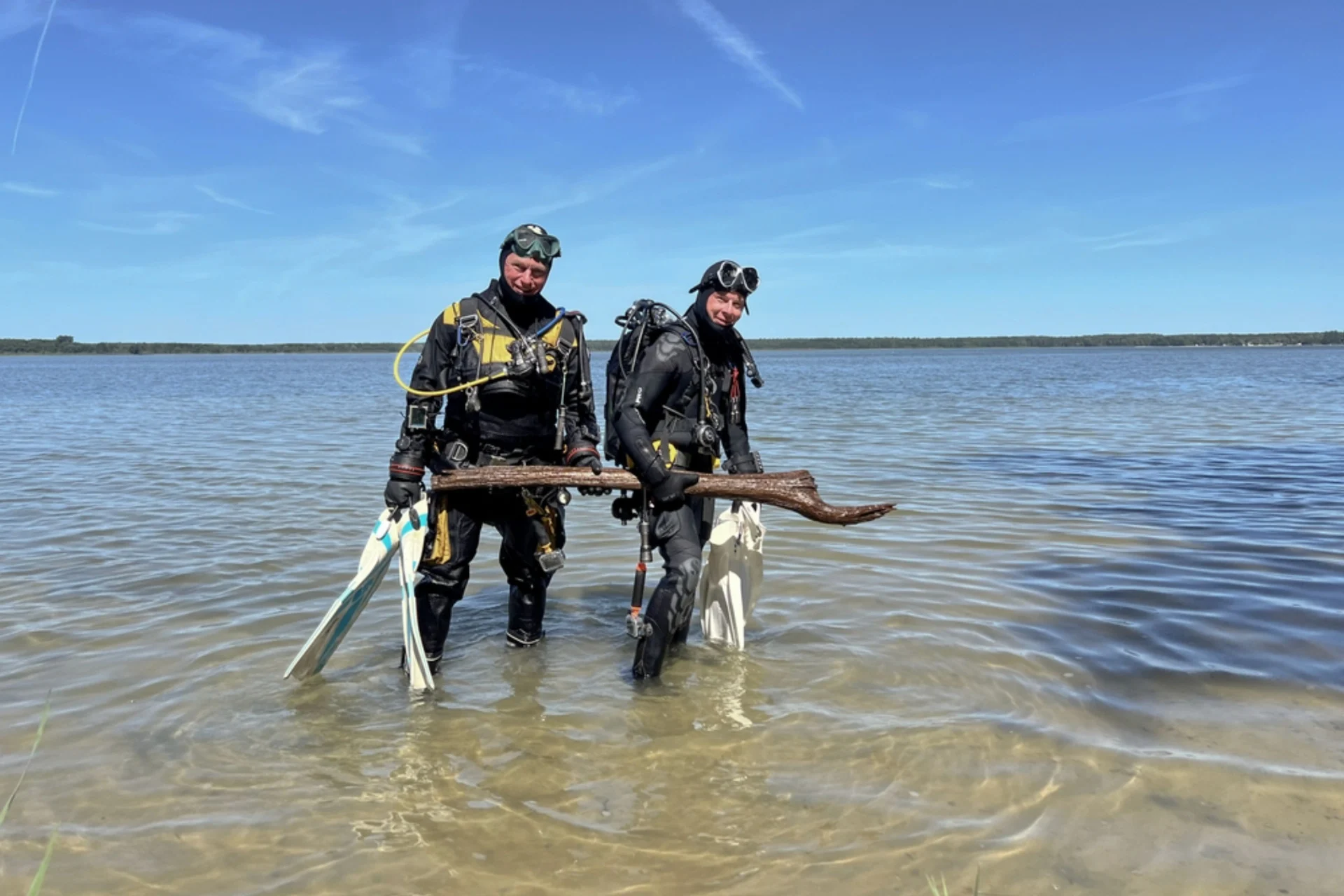
Underwater archaeologists in Germany have discovered prehistoric wooden remains that could seriously change our understanding of hunter-gatherers.
This past summer, researchers from the State Office for Heritage Management and Archaeology of Saxony-Anhalt found well-preserved pieces of wood dating back as far as 10,500 years ago in the state’s Lake Arendsee. If the wood had been modified by hunter-gatherers and the remains turn out to be parts of permanent structures, the findings would have significant implications for scientists’ understanding of the origins of cultural landscapes.
“Besides the usual finds from this period, such as stone tools or animal bones, our divers were able to recover spectacular pieces of wood, which have very rarely survived from this era,” Harald Meller, a state archaeologist, says in a translated statement. “The finds shed a completely new light on the Mesolithic period, for which traces of buildings in Central Germany have so far only been known in the form of soil discolorations.”
Mesolithic refers to both a time period—roughly 10,000 to 4,000 BCE, depending on the region—and a post-Ice Age way of life that marked a transition between Paleolithic hunter-gatherers and Neolithic farmers. People started to gather in small communities and slowly move toward early agricultural practices.
Lake Arendsee has preserved the traces of Mesolithic settlements because geological processes over an underground salt dome are causing its lake floor to slowly sink. 6 feet beneath the surface of the water—and it’s exquisitely preserved.
Source link





