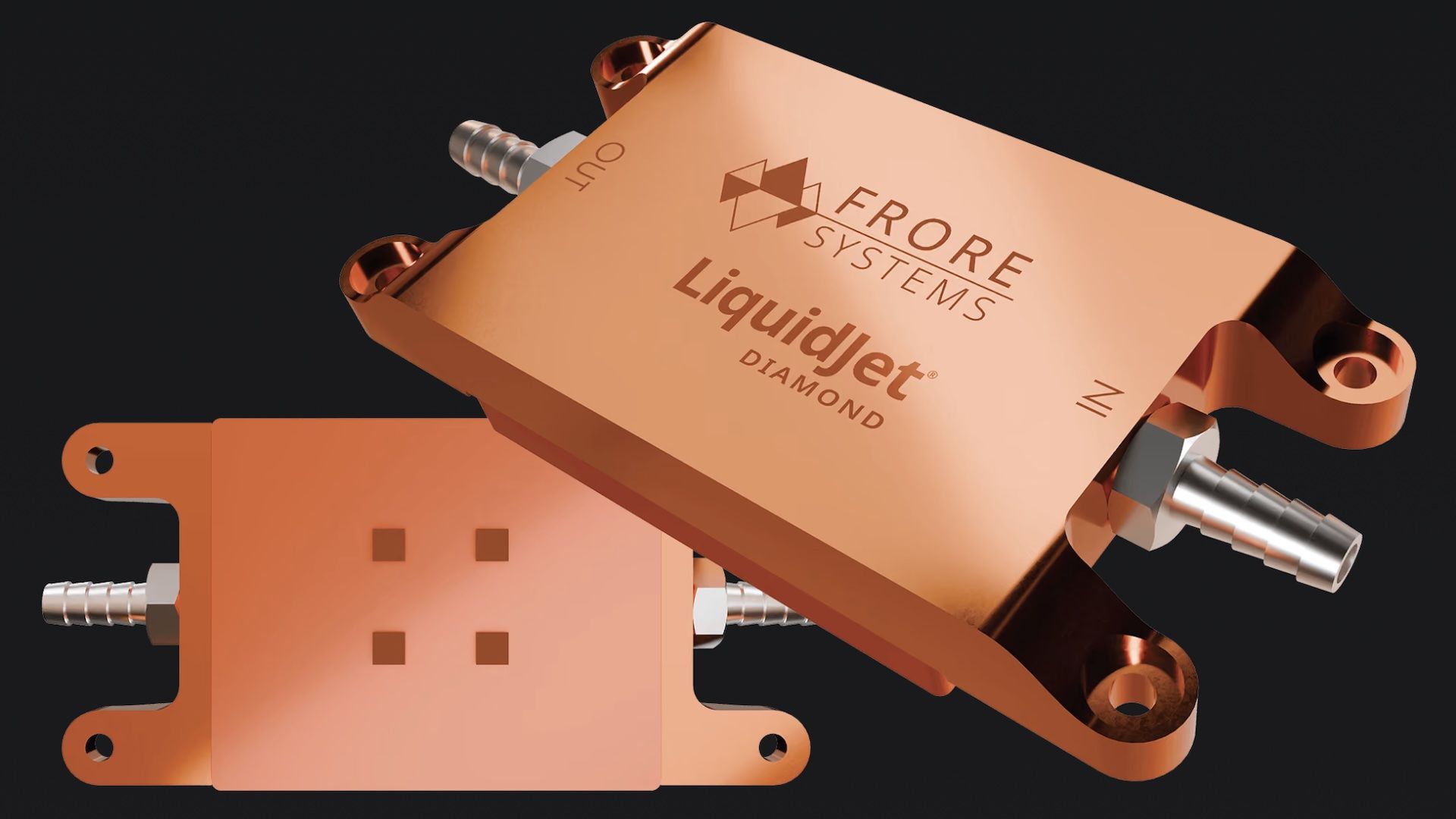
Frore Systems has introduced its bespoke LiquidJet Diamond liquid-cooling coldplate series that uses a diamond surface combined with a multi-stage 3D short-loop jet-channel microstructure to address precise hotspots on next-generation AI accelerators, such as AMD's Instinct MI400 and MI500-series, Nvidia's Rubin, and beyond. The company claims its new coldplates can handle hotspots with power densities reaching 770 W/cm², reduce GPU temperatures by up to 22C compared with conventional coldplates, and improve AI token throughput per watt by as much as 35%.
LiquidJet Diamond combines the expertise it used for its original LiquidJet coldplate product and the LiquidJet Nexus bespoke coldplate for Nvidia Blackwell and Nvidia Rubin-based servers. Unlike Nexus, which integrates multiple coldplates into a large cooling assembly for several processors, LiquidJet Diamond is an individual GPU coldplate, albeit a bespoke one.
From an internal technology perspective, Frore’s coldplates employ a three-dimensional, ultra-short-loop, multi-stage architecture with coolant channels customized for the power distribution of a specific processor. Meanwhile, the key innovation in LiquidJet Diamond is an additional heat spreader integrated into the bottom of the coldplate. This spreader incorporates diamond wafers positioned directly above the GPU’s hotspots to distribute heat more efficiently before it reaches the liquid-cooling structure. Diamond (carbon) has exceptionally high thermal conductivity, which can exceed 20 W/cm·K, compared with approximately 4 W/cm·K for copper. According to Frore, the addition of diamond heat spreaders allows LiquidJet Diamond to handle hotspots with power densities of up to 770 W/cm², compared with approximately 600 W/cm² for the original LiquidJet. However, the company has not disclosed how the diamond wafers are manufactured or integrated into the coldplate.
Source link