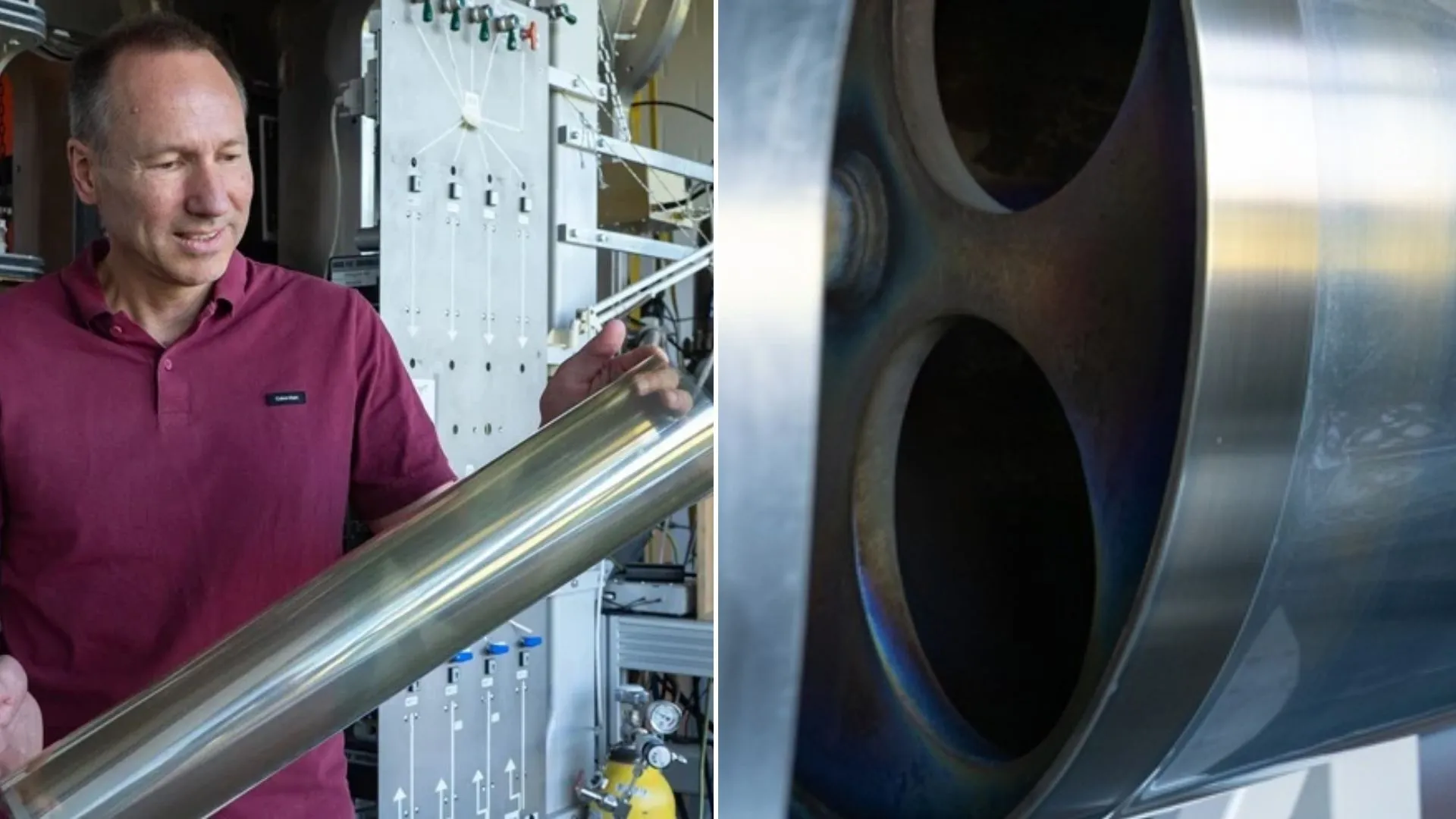
Researchers at Switzerland’s Empa research institute are developing a direct air capture technology that removes carbon dioxide from the atmosphere in cycles lasting less than one second. The approach replaces bulky porous filters with ultra-thin, amine-containing coatings that can rapidly absorb and release CO₂.
The technology is part of Empa’s Mining the Atmosphere research initiative, which explores ways to capture atmospheric carbon and turn it into reusable materials and chemicals. Researchers have conducted initial flow and process simulations, but experimental testing is still needed to determine whether the approach can compete with existing direct air capture systems.
Direct air capture systems typically move large volumes of air through porous materials that bind CO₂. The captured gas is then released, often by heating the material and applying a vacuum or steam.
Because atmospheric CO₂ concentrations are only around 430 parts per million, these systems must process large volumes of air to collect meaningful amounts of the greenhouse gas.
Empa’s approach takes a different route. Rather than maximizing the amount of CO₂ captured in each cycle, the researchers aim to capture smaller quantities much more frequently.
The proposed system uses ultra-thin coatings made from amine-containing materials. Instead of allowing CO₂ to penetrate deep into a porous adsorbent, the coating binds it at or near the surface. This reduces the amount of material that must be heated during the release stage.
“The process can be significantly accelerated thanks to the low thermal mass,” Empa researcher Dirk Hegemann explained in the institute’s announcement.
Source link