
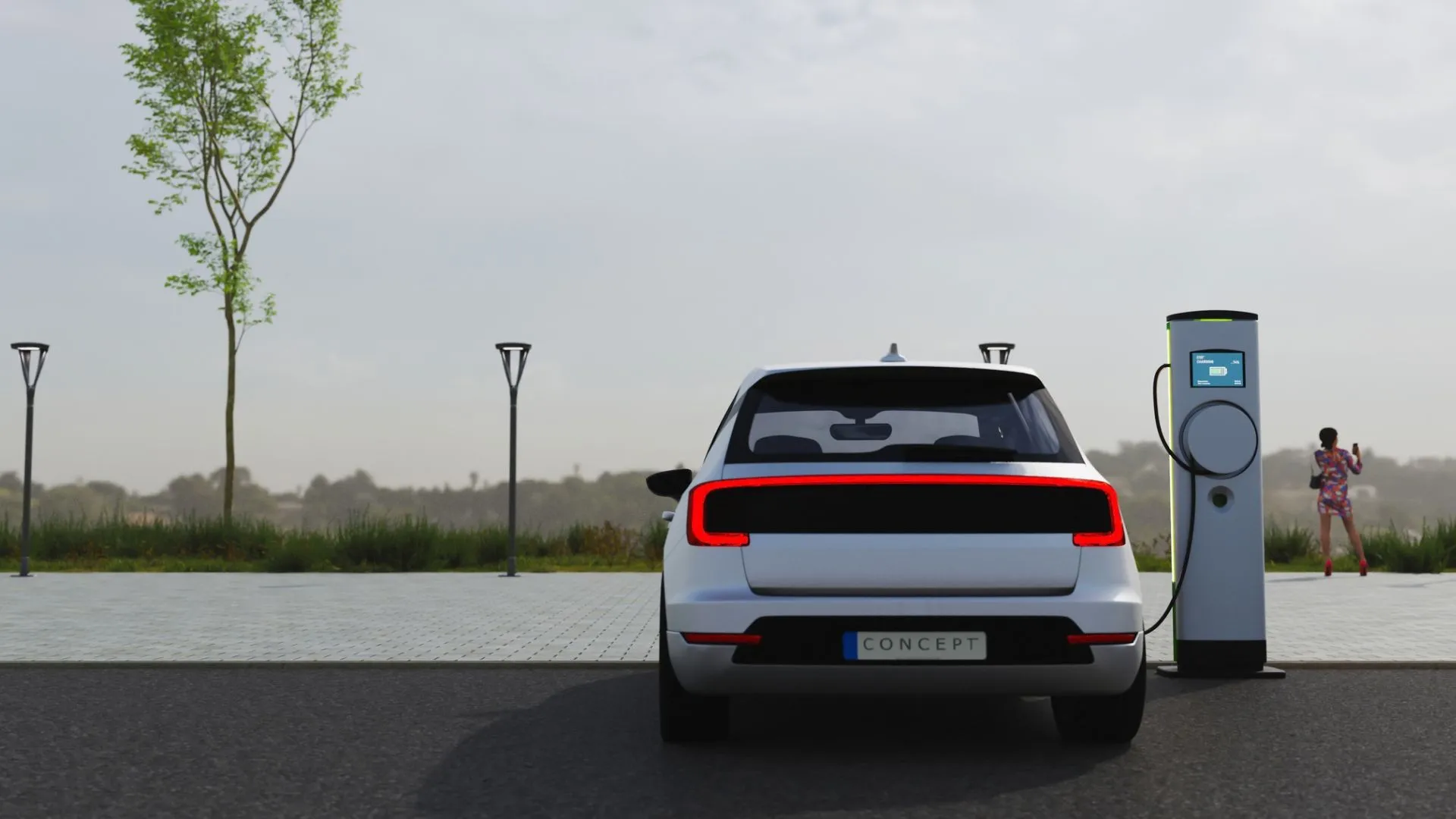
A joint research team from China and the UK has developed a 20 kW-class wireless charging system for new energy vehicles (NEVs) that breaks key thermal and efficiency barriers in inductive power transfer. Interestingly, the 20-kilowatt wireless charging system reaches an unprecedented 98.51 percent efficiency.
The Dongguan Institute of Materials Science and Technology under the Chinese Academy of Sciences (CAS) led the research, in collaboration with the CAS Institute of Physics, the City University of Hong Kong, and the University of Cambridge.
Self-driving electric vehicles can navigate complex roads, but their autonomy grinds to a halt when a manual plug-in is requirto recharge. This human dependency creates a major issue for fully automated transportation. Hence, the newly developed automated wireless charging technology aims to eliminate this limitation and allow autonomous fleets to operate and refuel without human intervention.
Usual wireless charging pads mostly use heavy ferrite cores to direct magnetic fields. Ferrite works well at low power, but when you crank up the wattage to charge a car quickly, the material fights back. It overheats, loses efficiency, and suffocates power density.
The researchers addressed this by using stress-annealed Fe-based nanocrystalline alloys with material–system co-design.
“Here, we report an inductive charging system utilizing Fe-based nanocrystalline alloys, developed through combined material and system-level optimization,” the team noted.
Engineers made a surprising design choice by favoring moderate magnetic permeability over maximum levels to balance system performance. This strategy led to the development of a compact magnetic core strip measuring 440 mm by 330 mm with a thickness of just 4 mm.
Source link





