
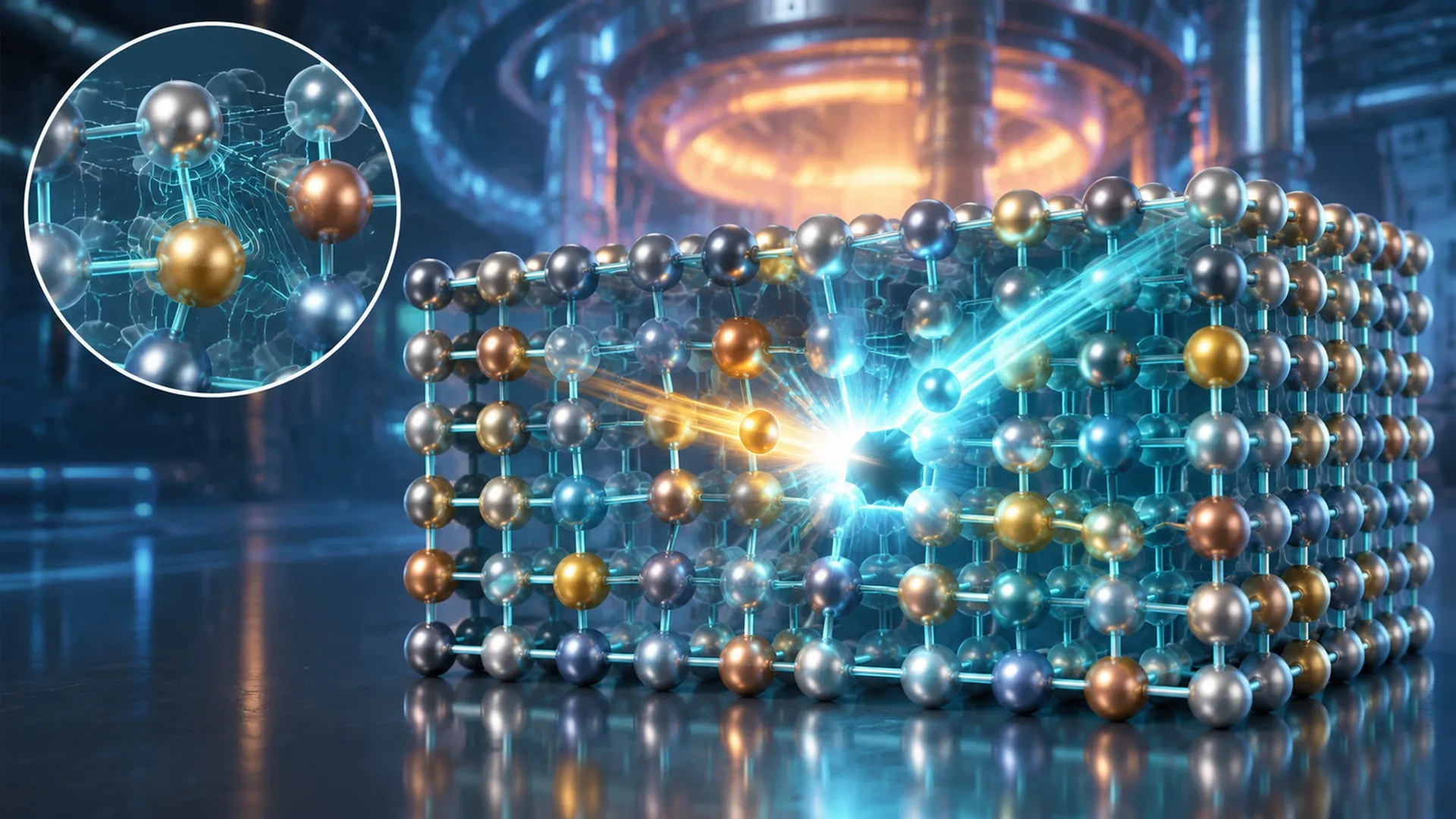
Researchers in China have reportedly identified a new way to develop self-healing metal alloys that could withstand radiation damage in nuclear and fusion reactors.
The research was carried out by scientists from the Chinese Academy of Sciences (CAS) and Xi’an Jiaotong University in China’s Shaanxi Province. For the study, the team examined multi-principal element alloys (MPEAs), which have several metals as their main components.
They found that tiny irregularities in the arrangement of atoms can influence how metals respond to radiation damage. This finding could make it easier to develop alloys capable of repairing damage at the atomic level.
Guan Pengfei, PhD, a researcher at CAS’ Ningbo Institute of Materials Technology and Engineering (NIMTE), and lead author of the study, stressed that the findings could lead to stronger, longer-lasting materials for nuclear energy and aerospace. “This work offers a new path for designing radiation-resistant alloys for extreme environments,” Guan added.
Multi-principal element alloys (MPEAs) are materials made by combining several metals, typically three or more, in nearly equal or moderate proportions, instead of relying on one base metal. They include medium-entropy alloys (MEAs), high-entropy alloys (HEAs), and compositionally complex alloys (CCAs).
These alloys usually stand out for their strong mechanical properties, resistance to radiation damage, and flexibility in composition. They moreover show promise for applications where traditional metals may not perform well.
However, developing them remains challenging, as scientists must examine how different combinations of elements behave when exposed to radiation. This, as a result, can involve a lot of calculations.
Source link





