
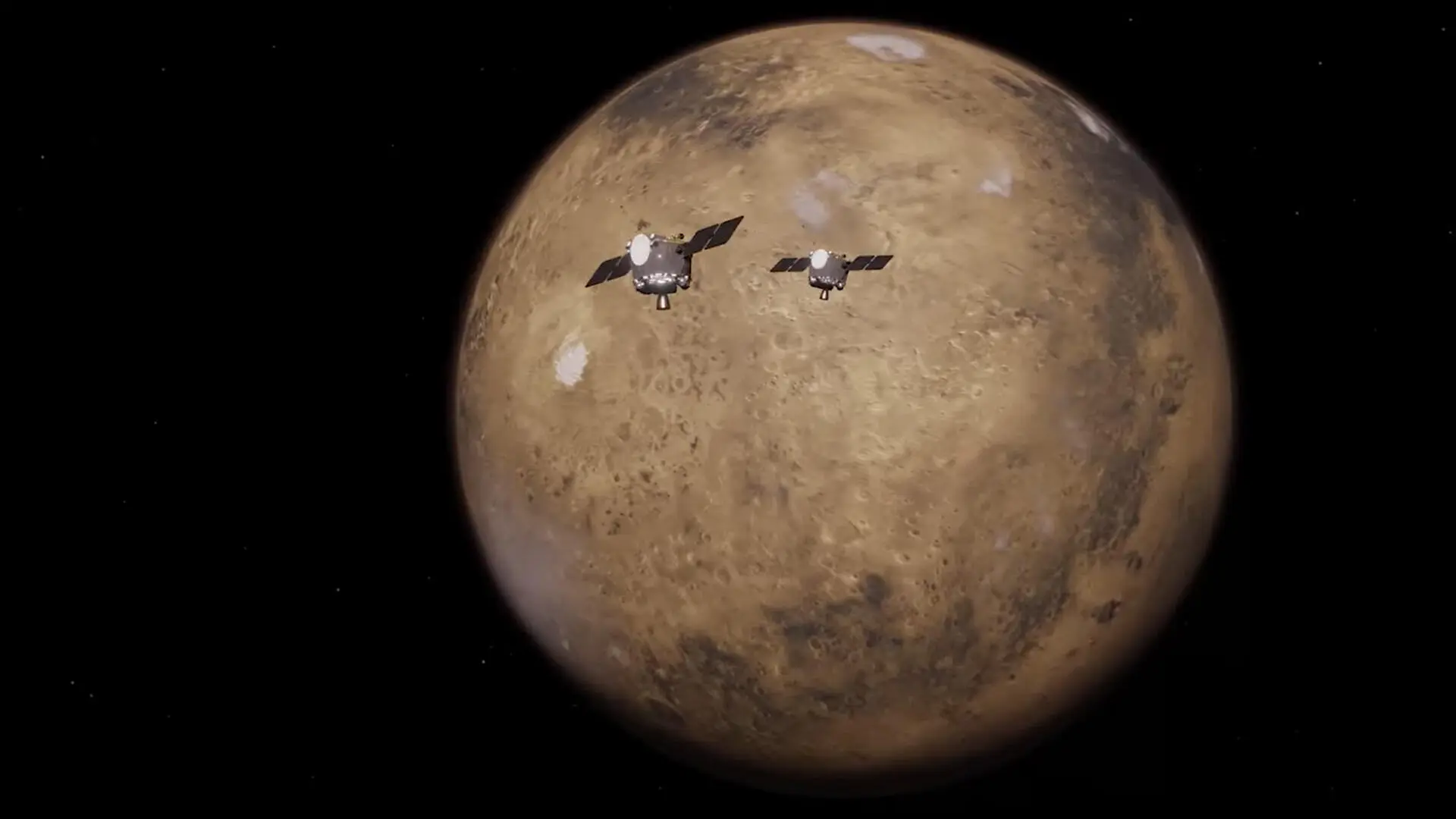
No space agency has ever staged spacecraft in orbit for a year before sending them on to Mars.
NASA launched its Escapade mission just over a year ago to send two spacecraft, nicknamed Blue and Gold, to Mars. After spending a year looping near Earth, the twin probes completed a gravity-assist maneuver this month and are now en route to the red planet.
It’s an exciting time for NASA. Blue and Gold, named for the school colors of UC Berkeley where they were built, completed the agency’s first powered Earth flyby.
Typically, spacecraft use a planet or the sun’s natural gravity to get close to the planet before slingshotting off into the distance. A notable example is Voyager 1, which used unpowered gravity-assisted flybys to reach the speeds needed to cross the light-day threshold earlier this week. Escapade did this with Earth’s gravity but also used thrusters to generate even more speed. Since there are two of them, NASA personnel had to perform this maneuver twice.
The other big win for NASA is that Mars will soon have two additional satellites in orbit to measure the planet’s magnetosphere, which is believed to have been stripped by the solar wind eons ago, when the planet likely had liquid water.
These satellites are notable for being NASA’s first low-cost mission to Mars, costing the agency approximately $75 million as part of the Small Innovative Missions for Planetary Exploration program. It also marked the official debut of Blue Origin’s New Glenn rocket for a space mission, and the company was able to achieve the first vertical landing of its rocket after sending Escapade on its way.
Source link





