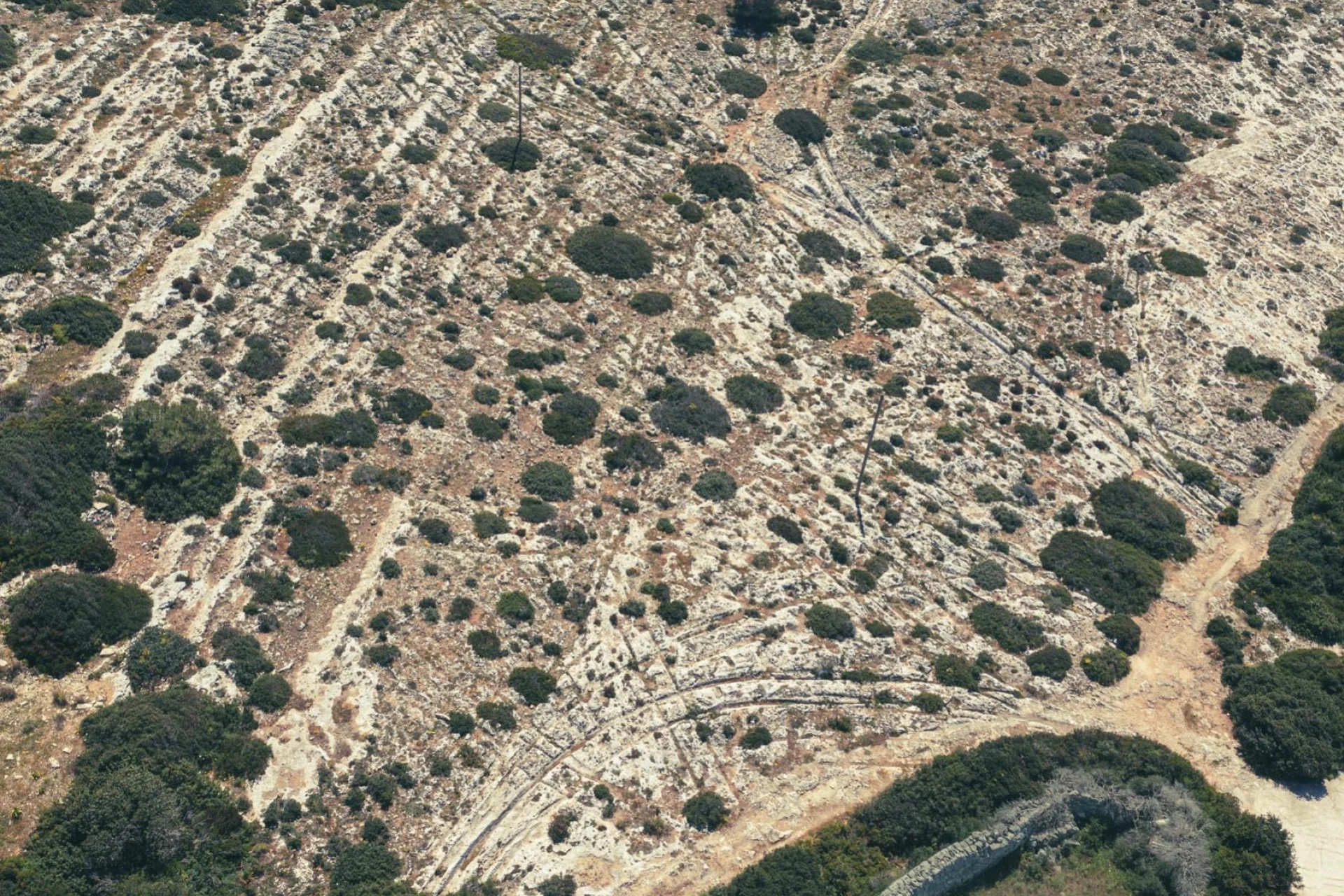
The Maltese archipelago has its own version of the Nazca lines: cart ruts. For centuries, archaeologists have puzzled over thousands of deep grooves etched onto the bedrock, forming an odd network of lines resembling a railway. The mystery grew as some suggested these “railways” were from prehistoric times—but a new study challenges this long-held hypothesis.
Joel Grima, a PhD student at the University of Malta, has made the Maltese cart ruts the central focus of his doctoral research. Accordingly, Grima has been deep in the trenches of the cart rut lore, and to Gizmodo, he explained that at first, he also favored a late prehistoric—specifically the Bronze Age—origin for the tracks. But as he dug further into evidence, he was “completely swayed by the sheer volume of evidence” supporting a later Classical date for the cart ruts. Grima recently published his findings in the Journal of Archaeological Science: Reports.
The paper “highlights how much of the supposed evidence for a prehistoric age is in fact comparatively indirect and circumstantial,” Grima told Gizmodo. “In light of this, it is very likely that a significant proportion (and possibly all) of Maltese cart ruts date to post-prehistoric periods.”
According to the paper, cart ruts like those found at Malta are a “firmly global phenomenon,” as similar tracks exist in Europe, Asia, and North America. However, these instances tend to be found within urban archaeological sites, making it easier for researchers to date and contextualize them.
What makes the Maltese ruts unique is their sheer density—which, considering the relatively small size of the islands, is “rivaled by few others,” Grima explained.
Source link