
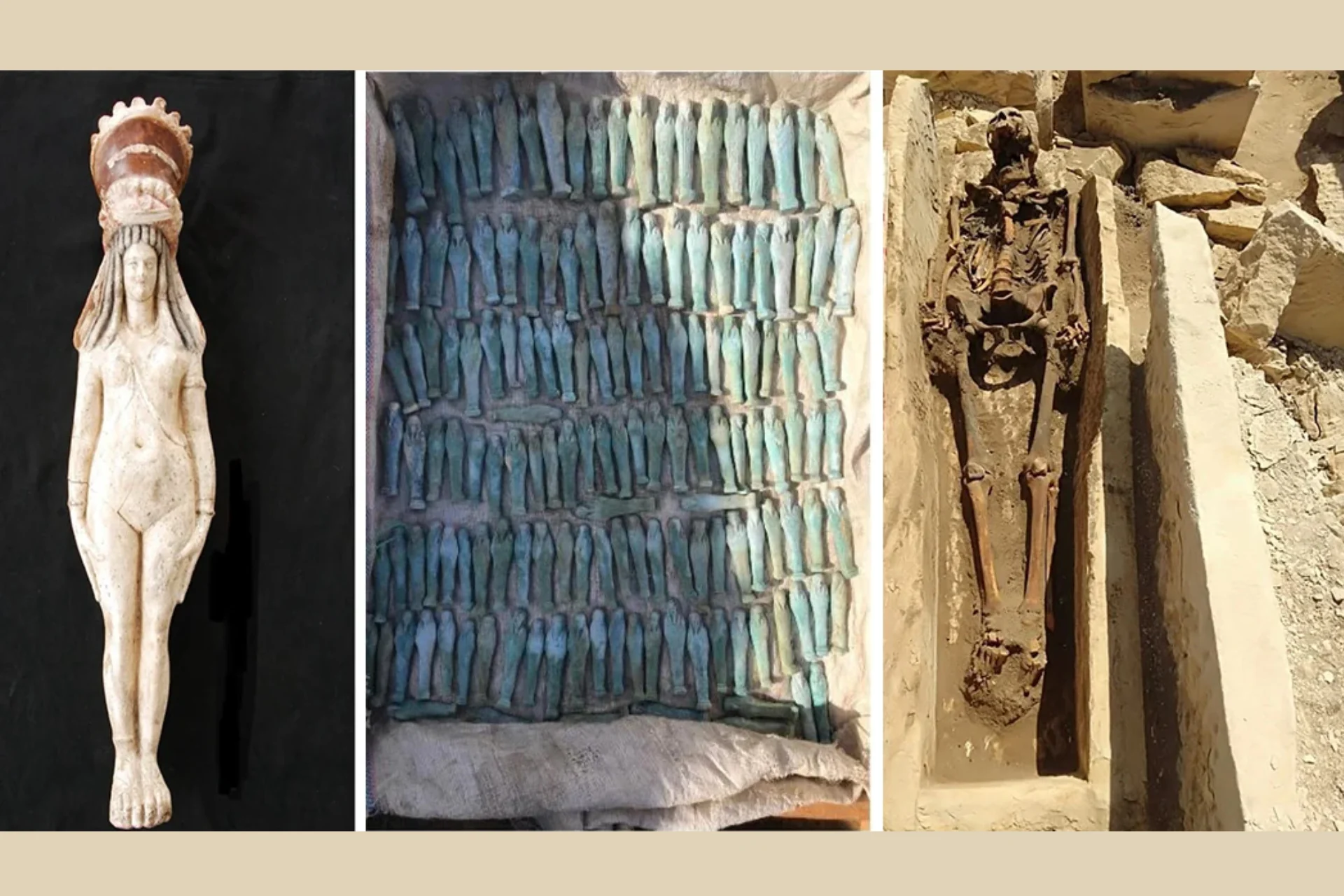
Archaeologists in Egypt have uncovered a cemetery more than 2,000 years old, with numerous tombs and burials likely belonging to members of the middle class.
The discovery is made significant by the impressive diversity of burial styles, coffins, and archaeological finds, which emerged in the Tell Abu Bello archaeological area in Menoufia Governorate. The Egyptian Ministry of Tourism and Antiquities announced the discovery in a statement on Wednesday.
The graves are from Egypt’s Late Period (around 664 to 332 BCE), Ptolemaic Period (around 332 to 30 BCE), and the start of the Roman Period (around 30 BCE to 395 CE). The team from the Supreme Council of Antiquities found a great diversity of burials: stone coffins, pottery coffins, the remains of wooden coffins, mud-brick domed tombs, and a tomb made with limestone.
The number of burials and coffins in an open burial courtyard marks the discovery as a first of its kind for Tell Abu Bello, said Hisham El-Leithy, Secretary-General of the Supreme Council of Antiquities.
There were specifically hundreds of stone coffins, some of which were lidless or shattered because of past vandalism and quarrying activity. Archaeologists also found many remains from various kinds of pottery coffins (a widespread kind of ancient Egyptian coffin). Some had caricatured human features and others bore a direct human representation.
Furthermore, the team unearthed poorly preserved human remains whose analysis revealed traces of embalming materials and resins and remains of yellow, red, blue, and gold cartonnage (an ancient funerary material) and plaster. There were also two falcon burials, golden tongues, an earring, small amulets, a necklace pendant, golden strips, scarabs, offering tables, small limestone statue heads, small sphinx statues, and fragments from Horus statues.
Source link





