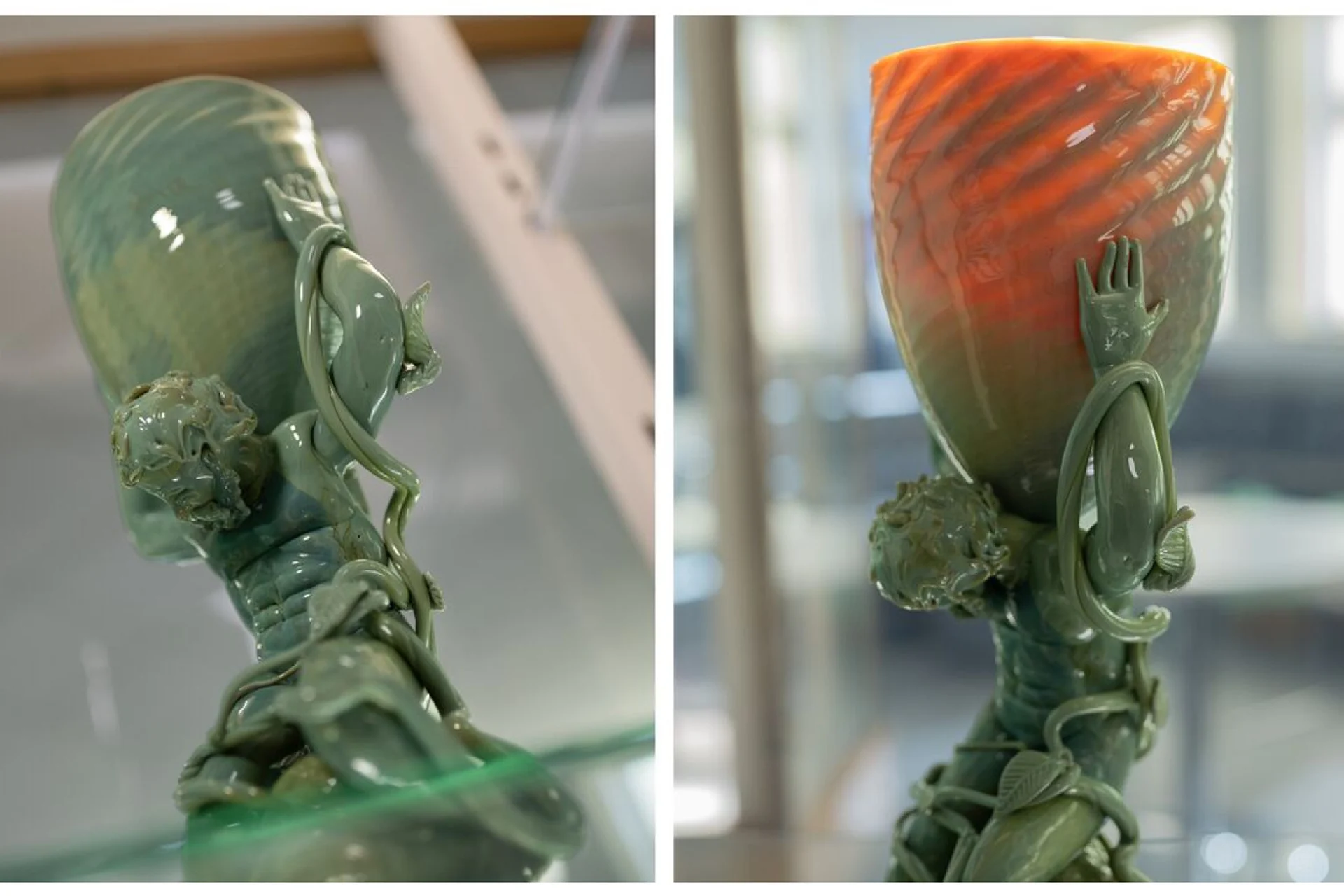
For years, the Lycurgus Cup has captivated art historians, glassmakers, and scientists. Crafted in the 4th century, the Roman cage cup’s glass body transforms from jade green to ruby red under a backlight—an effect modern scholars struggled to properly reproduce until now.
In a recent announcement, the University of Sheffield in the U.K. reported that its experts had successfully emulated the optical effect observed in the Lycurgus Cup. For context, the cup is made of dichroic glass, a material that shifts color depending on the angle of view. Research conducted in the mid-20th century indicated that tiny nanoparticles of gold and silver—smaller than wavelengths of light—contributed to the unique color change. However, the team led by Lisa Hollands, a technical specialist in glass at ceramics at Sheffield, is the first to actually demonstrate a working, repeatable recipe in modern times.
“I accepted the challenge knowing that it might not work, as I knew it wasn’t as simple as embedding nanoparticles off the shelf into a glass,” Hollands told Gizmodo. The project began as a request from the university’s photonics team for public outreach but grew into a “mini research project” with fascinating implications for science, she added.
” For sure—you don’t need to be a professional glassmaker to appreciate the mastery required to craft an ornate “cage” over a glass cup. But the Lycurgus Cup is even rarer in that the design of its cage is figurative rather than geometric, Hollands explained.
Source link