Khaled el-Shahat Khalil was working on his land in Behbeit el-Hagar, a village in northern Egypt’s Gharbia, when he found an unusual, inscribed stone outside his home. He reported it to the local antiquities authorities, providing the first clue to something extraordinary buried beneath the surface of this ancient landscape.
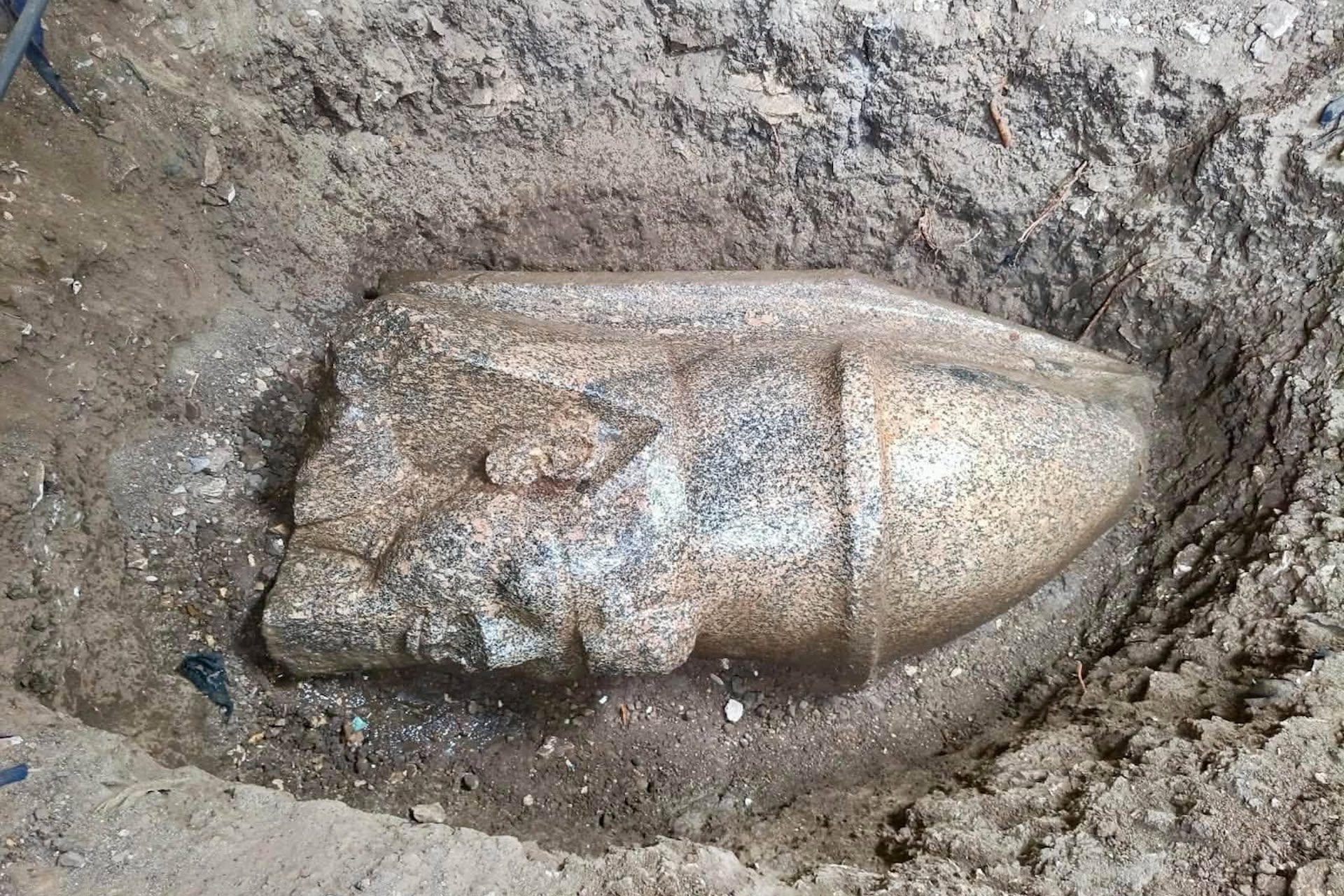
The initial find prompted an archaeological excavation, as experts set out to determine whether the stone was an isolated relic or part of something much larger. Beneath the plot of land in the Nile Delta were the remains of two colossal statues, at least one of which belongs to Ramses II, and a pink granite block bearing ancient Egyptian hieroglyphic inscriptions, including the pharaoh’s royal titles, according to the Egyptian Ministry of Tourism and Antiquities.
The discovery raises questions as to how the Ramses II statue ended up in the village where an ancient temple once stood nearly nine centuries after the pharaoh’s reign had ended.
The recent discoveries were made by a rescue mission affiliated with the Supreme Council of Antiquities (SCA), which inspected the site to confirm the archaeological significance of the find.
6 meters) tall, depicting Ramses II wearing the double crown, a royal symbol representing the unification of Upper and Lower Egypt. Next to the head was the upper piece of the statue’s back pillar, which was inscribed with one of the five names given to the king, Hor Kanakht Meri-Maat. The name translates to “Horus, strong bull, beloved of Maat,” establishing Ramses II as a living incarnation of the god Horus and his alignment with the goddess of cosmic order, Maat.
Source link