
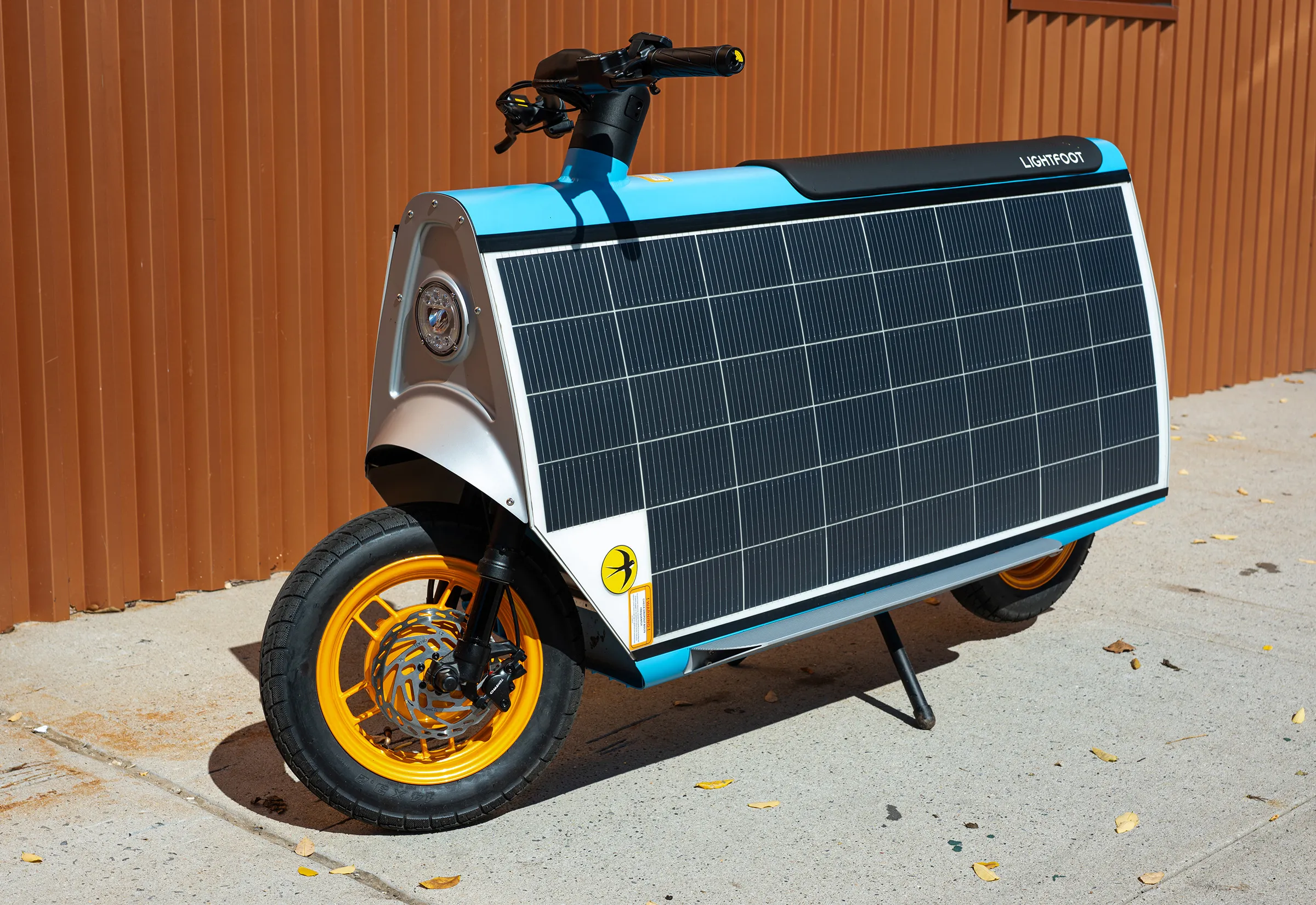
I stepped out of a building in New York City, put on my helmet, and was about to hop onto my scooter. That’s when I caught a passerby staring at the thing I was about to straddle: a funky-looking solar-powered two-wheeler called the Lightfoot. We locked eyes, and he asked, “Did you make that?”
That's essentially what the Lightfoot feels like—something tinkered into existence in a garage, rather than a factory overseas. It's like a rectangular pod on wheels, with two large solar panels on the side and a bench seat up top that fits a rider and a passenger. It's designed to be ridden in the bike lane—without pedals, it's designated as an electric scooter rather than an ebike—and has a top speed of 20 miles per hour.
Almost everyone who sees it says it looks ridiculous, but in a fun, whimsical sort of way. No doubt that's why its maker dubs it the “smile machine.” No other vehicle I've ever ridden has commanded this much attention. People have commented on the Lightfoot at traffic lights and even mid-ride, where several cyclists precariously pulled out their phones to take photos.
The Lightfoot hails from Otherlab , a research and design company founded by inventor Saul Griffith , who also cofounded Rewiring America , a nonprofit that helps US households switch from fossil fuels to clean energy. Griffith tells WIRED that the project started several years ago after publicly available data showed that 52 percent of all US passenger trips across all modes of transportation were less than three miles.
Source link





