
Anyone who has watched Back to the Future II, a science-fiction movie that came out in 1989, has been eagerly waiting to ride the hoverboard that Marty McFly rode. But no one knew how long the wait would be before the technology reached the market.
Ten years ago, things began to change as multiple attempts were made over the years to develop the technology. While none has yet delivered a commercially viable hoverboard, enthusiasts continue to push the concept further.
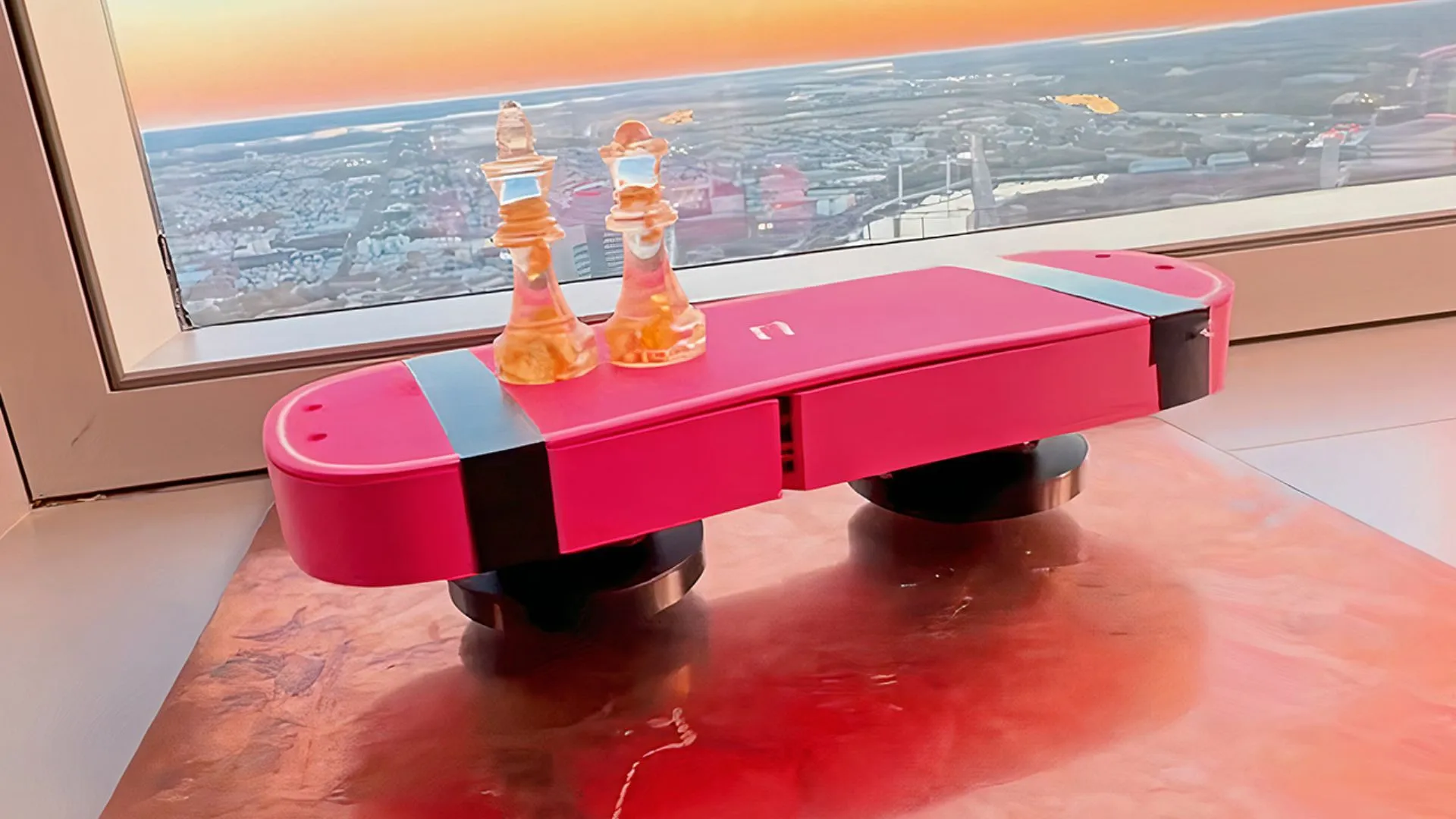
Recently, Jake Rogers tried his hand at making a palm-sized hoverboard using 3D-printed material, magnets, brushless motors, and a bunch of knick-knacks from his garage.
After spending weeks on the project, he built a miniature hoverboard that he describes as a working prototype that floats above a thick copper plate, completely untethered, with no wheels or air cushion.
The final design houses two rotors spinning in opposite directions, electronic speed controllers (ESP2), a converter that drops the voltage for the board, and two batteries inside the 3D-printed soft pink casing made with polymaker filament.
To maximize performance, Rogers also custom-printed the rotors to accommodate a ring of twelve N52 neodymium magnets organized in a Halbach configuration. He chose the specific arrangement to ensure that the strong field points downward while the weak field above remains weak.
However, he arrived at this untethered, battery-powered version only after multiple rounds of adjustments and testing. During his early trials, he started with a single motor to lift a lightweight frame off the ground.
Source link





