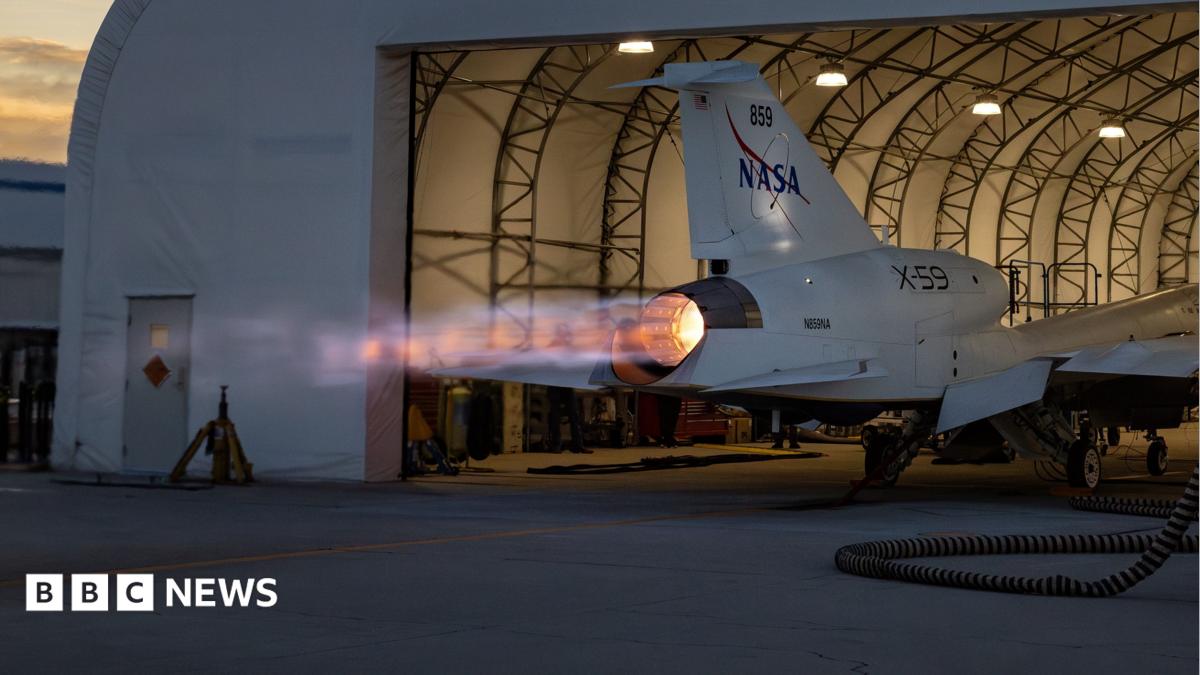
The long nose of the X-59 is designed to damped the plane's sonic boom
There's a weird and wonderful jet flying over the US. It has the nose of anteater, parts cannibalised from other planes and a cockpit so far back the pilot depends on a camera to see where he's going.
This contraption, the X-59, might just be the future of air travel.
The X-59's owes its eccentric design to the problem of sonic booms. The shockwave created by a jet breaking the sound barrier restricted Concorde to flights over the sea and barred it from lucrative routes across the US.
Now Nasa is working around that problem using the X-59's elongated snout to flatten supersonic booms into tolerable bumps in the background.
On top of its bizarre appearance the X-59 boasts a remarkable lineage. It's the latest in a series of experimental Nasa aircraft dating back to 1947 and the first plane to break the sound barrier, the Bell X-1.
Peter Coen, a 43-year Nasa veteran who manages the programme, explains the thinking behind 80 years of X-planes. "Our approach is to pick small goals we aim to prove with flight data and we construct an airframe for that one task."
The X-plane philosophy is to "minimise goals, the more goals you have the more expensive it gets." For the X-59 it's about suppressing sonic booms on a budget and nothing else.
50 calibre bullet travelled faster than the speed of sound. So the stumpy little aircraft was shaped like a bullet with wings added.
Source link