Pew Research Center has released a new study exploring how the sizes of seven major religious groups will change by 2070, if recent trends continue. We project that the populations of some of these groups will grow rapidly, while others will decrease over time.
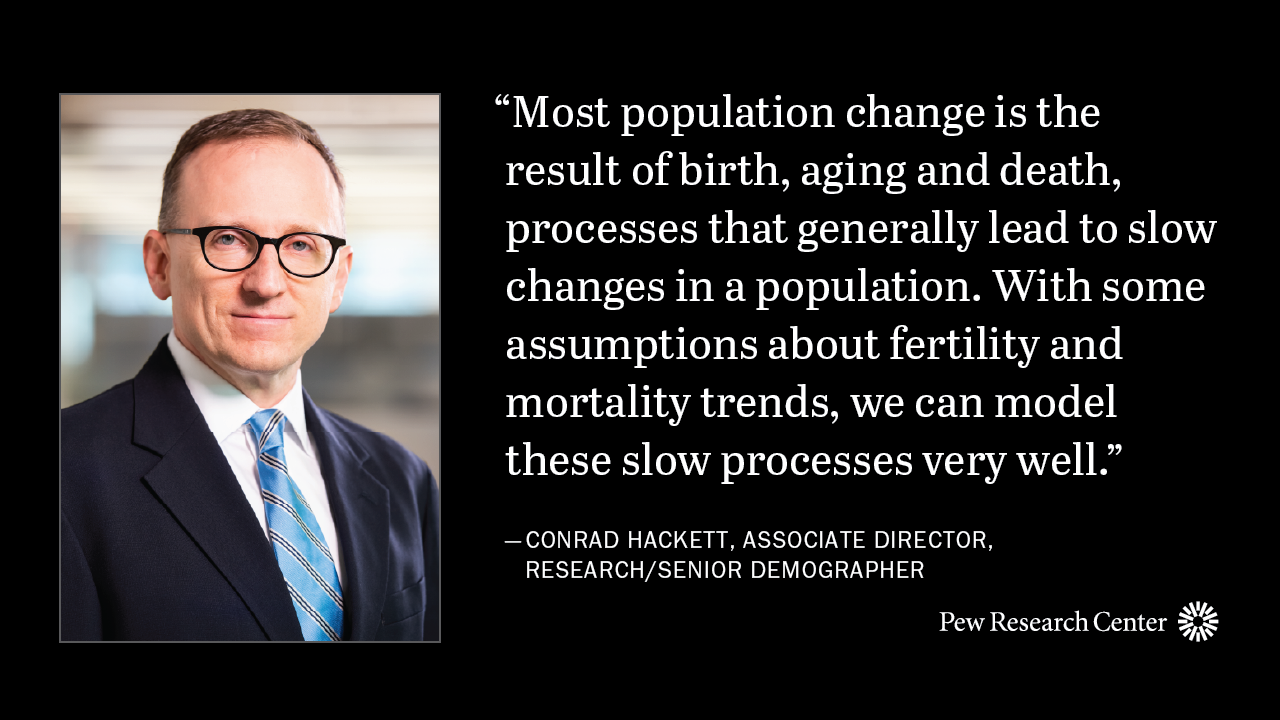
In this Q&A, we speak with Senior Demographer and Associate Director of Research Conrad Hackett about how the Center makes its projections. The interview has been condensed and edited for clarity.
A projection estimates what the future size of a population will be if certain assumptions prove correct.
Typically, demographers make projections by dividing a population into groups – or “cohorts” – based on age and sex, like women ages 15 to 19 or men ages 40 to 44. Then we estimate how many births and deaths will occur over time in each cohort. Projections may also include estimates of how many people will migrate from one country to another.
Our projections look at the sizes of specific religious groups in each country, so we also estimate how many people in a particular place will switch from the group in which they were raised to a different group.
About three-in-four people worldwide identify with a religion. But by 2070, the religious makeup of various geographic regions will look very different than it does now, since religious groups grow at different rates.
Surveys often measure the religious identity of adults at the country level. In some cases , national censuses also measure religion. However, without doing a lot of work to analyze this information, we wouldn’t know the big picture or what kinds of changes are happening at the regional and global levels.
Source link