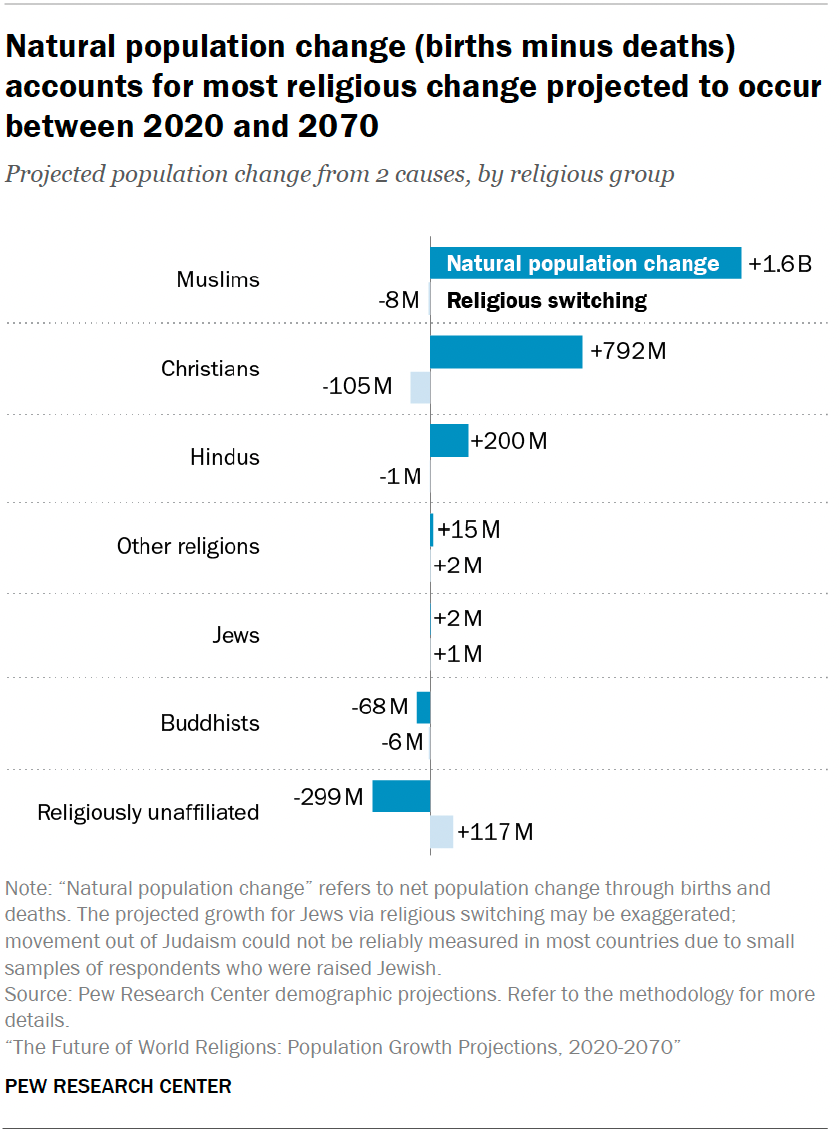
We project future changes in the size and geographic distribution of seven religious groups – Christians, Muslims, Hindus, Buddhists, Jews, followers of all other religions and religiously unaffiliated people – between 2020 and 2070. The projections cover 201 countries and territories, which collectively account for 99.98% of the world’s population.
The results are not intended to predict all the ways the world could change. There are many events that could affect religious group populations (including wars, natural disasters, epidemics, and changes in economic or social circumstances) that are not analyzed here.
This research is part of the Pew-Templeton Global Religious Futures project, which analyzes religious change and its impact on societies around the world. It builds on our recently published work measuring the world’s recent religious makeup.
Many countries make demographic projections to try to forecast how their populations may change. The most common projection method – used by researchers for more than a century – starts by estimating the size of a country’s population in groups (“cohorts”) divided by age and sex, such as the number of girls ages 0 to 4, 5 to 9, 10 to 14, etc. Each cohort is then projected into the future, modeling how its size will change every five years with the addition of expected births (based on fertility rates) and the subtraction of expected deaths (based on mortality rates). Demographers also often attempt to forecast future levels of immigration and emigration.
Our projections use an advanced version of this method.
Source link