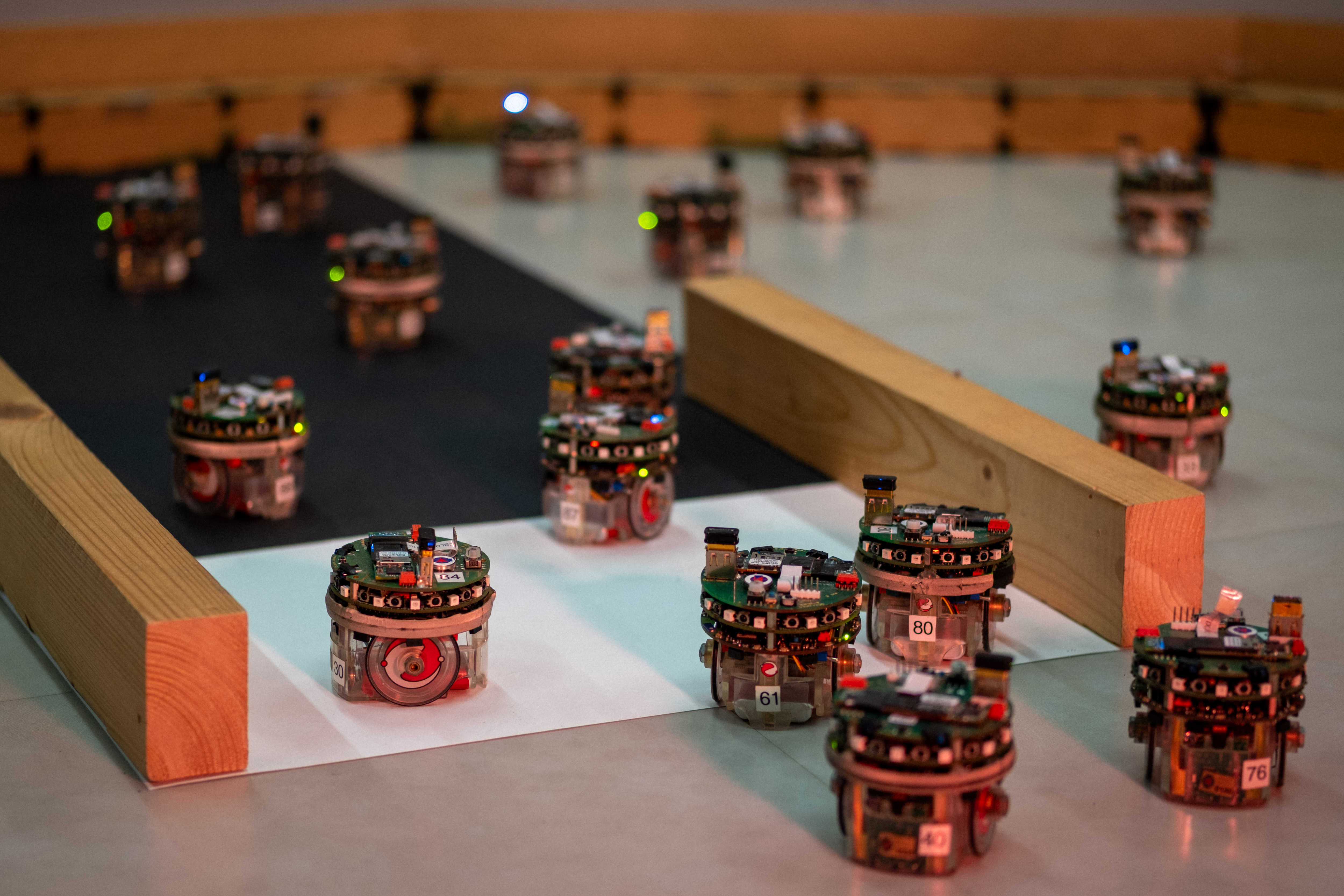
Reinforcement learning lets robots learn behaviors on their own, through trial and error, usually inside a computer simulation. Moving what they learn onto physical robots is another matter. Simulated and real robots never behave quite the same way, a mismatch known as the “reality gap,” and reinforcement learning has long been particularly sensitive to it. Researchers at IRIDIA, the artificial intelligence laboratory of the Université libre de Bruxelles (ULB), have shown how to get around it for robot swarms: swarms trained with their method in simulation keep performing reliably once they are moved onto real robots.
Teaching a swarm of robots to search for survivors after an earthquake, or to explore a hostile site, entirely inside a computer before risking a real machine sounds like the sensible way to do it. The catch is the reality gap. Friction, sensor noise and mechanical imprecision rarely behave the way they do in a simulation, and skills learned there tend to fall apart when a robot meets the real world.
Ilyes Gharbi, Mauro Birattari and colleagues at IRIDIA (Brussels School of Engineering, ULB) report their results in Science Robotics.
Reinforcement learning has become one of the most powerful tools in robotics for producing complex behaviors automatically, and it is behind some of the most striking recent advances in legged locomotion and robotic manipulation. Swarm robotics followed a different path. Its own tradition of modular design methods assembles robot behaviors from predefined building blocks. These methods transfer reliably to real robots, but they rely on slow, costly search procedures.
Source link