This article has been reviewed according to Science X's editorial process and policies. Editors have highlighted the following attributes while ensuring the content's credibility:
The machines used at construction sites to lift heavy loads and move materials are typically operated by humans. These machines often have complex mechanical and hydraulic responses, while their size and the heavy loads they carry make errors potentially dangerous.
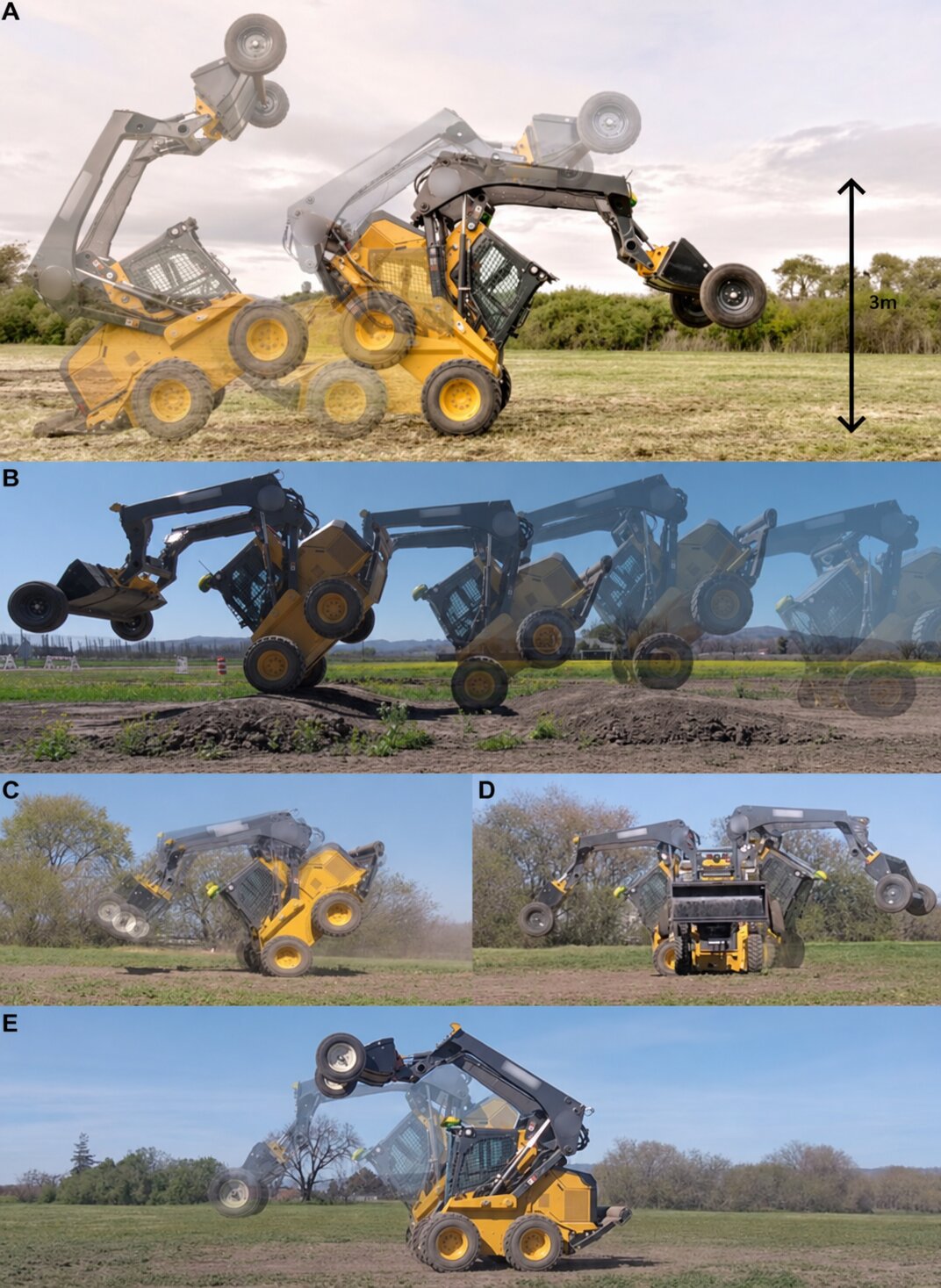
For these reasons, many of the tasks carried out by construction machines have proved difficult to automate, even with the use of sophisticated artificial intelligence (AI) and robotic systems. A team of roboticists at ETH Zurich, Blue River Technology, Gravis Robotics and Intel's Intelligent Systems Lab recently developed new robot policies that allowed a five-metric-ton (11,000-pound) construction loader to perform acrobatic maneuvers autonomously.
The researchers trained the policies in simulations using reinforcement learning (RL), an approach that allows computer systems to learn by repeatedly attempting tasks and receiving rewards for desirable outcomes. The policies, presented in a paper published in Science Robotics, were then successfully transferred to a John Deere 332G, a real skid-steer loader used in construction.
"Automation of heavy machinery offers the opportunity to improve productivity in mechanized industries such as construction, mining and material handling," wrote Pierre-Jean Lorentz, Pascal Egli and their colleagues in their paper. "Yet, automation of such machines is challenged by their complex dynamics, in part because of hydraulic actuation that involves fluids, flexible elements and nonlinear delays.
Source link