This article has been reviewed according to Science X's editorial process and policies. Editors have highlighted the following attributes while ensuring the content's credibility:
Artificial intelligence systems are now widely used in research settings, primarily to analyze data, make predictions and discover promising materials, drugs or solutions. Most of the agents used for research are disembodied, which means that they are computer-based and require humans or separate automated systems to physically perform experiments.
More recently, some computer scientists have been exploring the possibility of developing embodied AI agents that can both plan and execute scientific experiments. These agents typically combine AI agents with robotic systems that can interact with their surroundings.
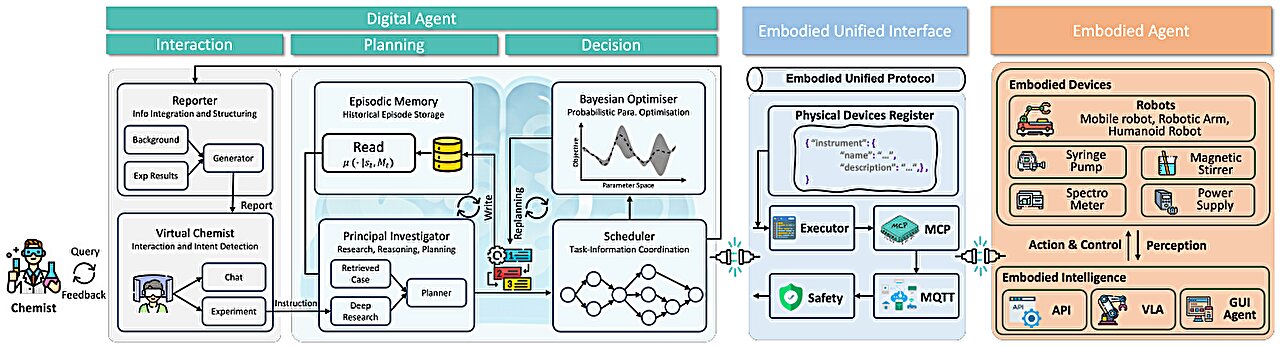
Researchers at University College London (UCL), the Hong Kong University of Science and Technology (Guangzhou) and other institutions recently developed a new agent for planning and conducting science experiments, called embodied science agent (ESA). Presented in a paper posted to the arXiv preprint server, ESA was able to autonomously plan and run wastewater treatment experiments involving dye removal.
Most previously developed embodied agents for scientific discovery rely on AI agents to plan experiments and robotic systems to execute them. However, the authors argue that many of them remain limited in how closely they connect the planning of experiments with physical feedback and learned skills enabling the control of scientific instruments.
"By treating models as disembodied planners that output symbolic workflows for separate robotic systems, current architectures inherently block the development of embodied experimental intuition," wrote Yihang Chen, Zhongwei Yu and their colleagues in their paper.
Source link