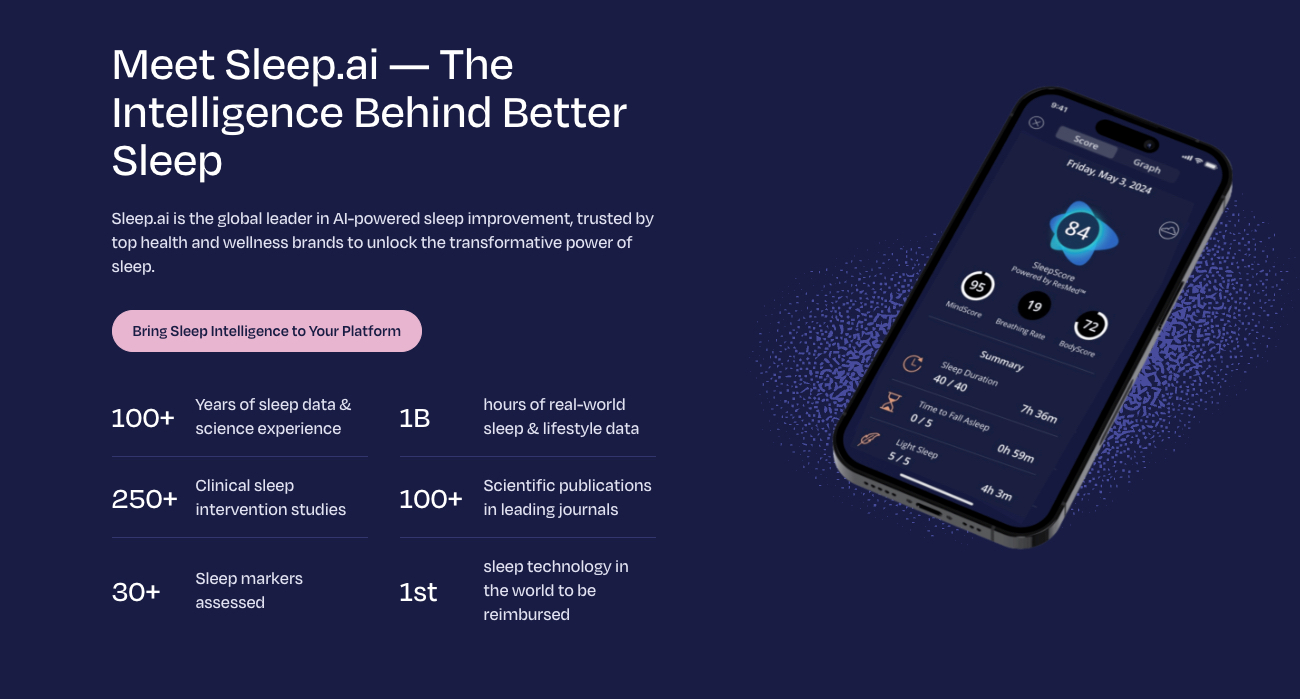
Formerly operating within the consumer-facing SleepScore Labs ecosystem, Sleep.ai has consolidated its intellectual property into an enterprise, business-to-business software-as-a-service intelligence engine designed to eliminate hardware lock-in. The core platform ingests and normalizes raw telemetry across approximately 800 distinct consumer wearables, applying algorithmic calibration to standardize sleep latency, wake after sleep onset, sleep staging, and duration metrics into a single consistent data schema.
For individuals who do not own a wearable tracker, Sleep.ai’s proprietary Sleep Sense software repurposes everyday smartphone microphones and speakers into non-recording, privacy-preserving sonar sensors. The system monitors nocturnal micro-respiratory patterns and physical movement without capturing raw acoustic audio, ensuring continuous tracking across low-income or non-wearable-owning populations. Partners embed this capability directly through application programming interfaces and software development kits, allowing their users to receive continuous clinical guidance regardless of whether they own dedicated biosensor hardware.
Beyond basic sleep duration tracking, the platform cross-references longitudinal sleep patterns against validated predictive models to screen for serious chronic conditions, including obstructive sleep apnea. Validating this diagnostic capability, Sleep.ai recently published its 104th peer-reviewed scientific paper at the European Sleep Research Society’s Sleep Europe 2026 congress.
The study examined the integration of limited questionnaire data with real-world sensor streams to screen for obstructive sleep apnea risk, establishing an evidence-based foundation that allows digital health applications to identify undiagnosed respiratory disorders before patients present with acute cardiovascular complications.
ai has established a sustainable reimbursement pathway through the German statutory health insurance system. Branded as Dein Schlaf (“Your Sleep”), the program is formally certified by the Central Prevention Center under Section 20 of Book V of the Social Code.
Source link