
This article has been reviewed according to Science X's editorial process and policies. Editors have highlighted the following attributes while ensuring the content's credibility:
Metabolic dysfunction-associated steatotic liver disease (MASLD) is a major cause of liver-related morbidity and mortality worldwide. As the disease progresses, liver fibrosis and liver-related events (LREs), including hepatocellular carcinoma and other complications, become important indicators of clinical risk. However, accurately assessing fibrosis severity and predicting future LREs remains challenging. Liver biopsy is invasive and costly, while existing noninvasive biomarkers and imaging approaches have limitations.
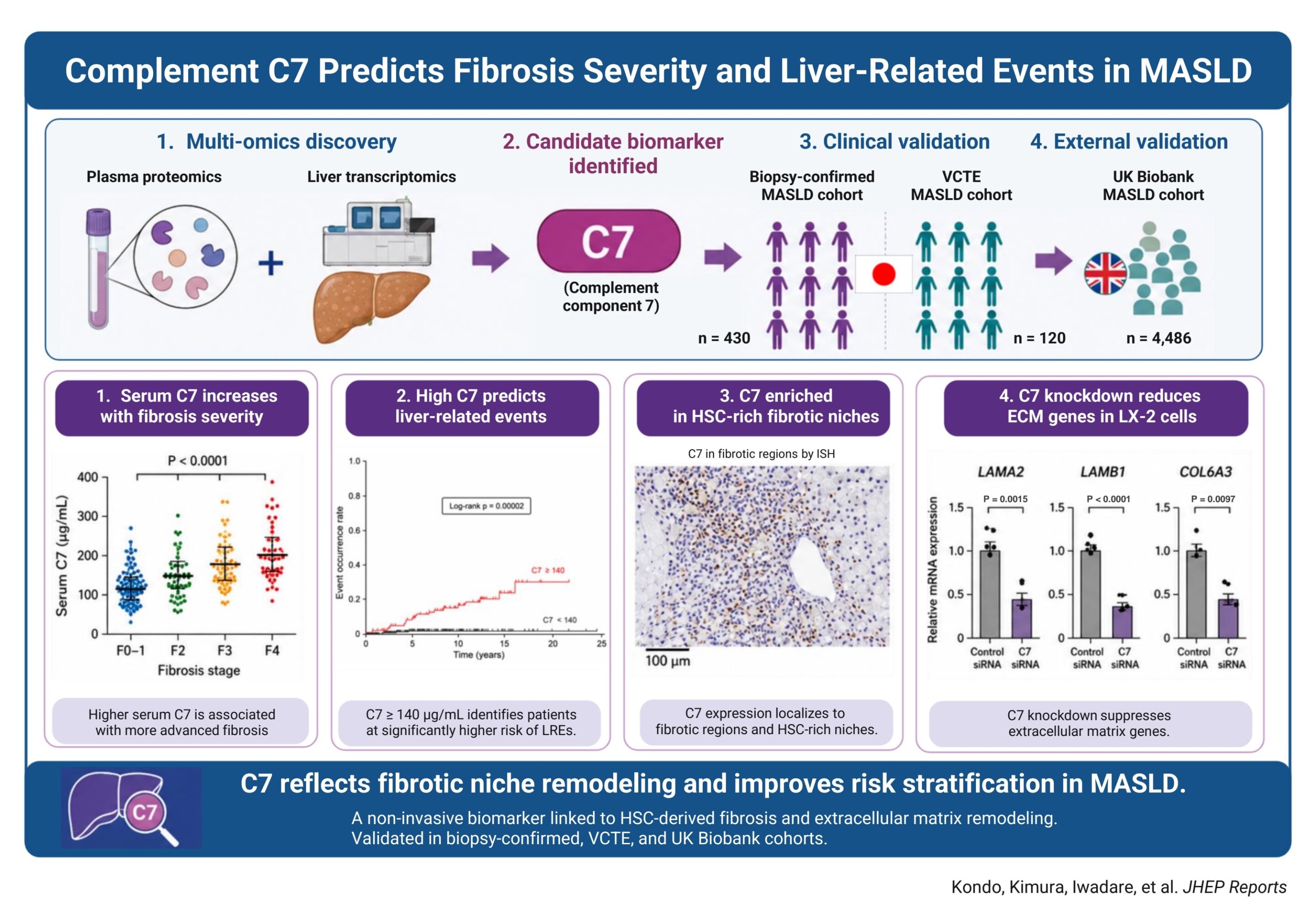
To address these challenges, a research team led by Dr. Takefumi Kimura, together with Dr. Shohei Kondo, Dr. Takanobu Iwadare and Dr. Naoki Tanaka from Shinshu University in Japan, investigated potential biomarkers of fibrosis and disease progression. The paper was published in the journal JHEP Reports. The researchers used an integrative multi-omics approach to investigate complement C7 as a potential biomarker of fibrosis and liver-related events in MASLD.
According to Kimura, "This study identified complement C7 as a novel biomarker associated with fibrosis progression and LREs in MASLD using a comprehensive multi-omics approach."
The researchers evaluated C7 across independent cohorts, including 430 patients with biopsy-confirmed MASLD, 120 patients assessed using vibration-controlled transient elastography (VCTE) and 4,486 UK Biobank participants. Serum C7 levels were associated with fibrosis stage and liver stiffness. A serum C7 threshold of 140 μg/mL was also associated with higher LRE incidence. 82).
Source link





