
This article has been reviewed according to Science X's editorial process and policies. Editors have highlighted the following attributes while ensuring the content's credibility:
The COVID-19 pandemic showed the challenges of protecting populations when a new respiratory virus emerges. Although vaccines were developed at unprecedented speed, there was still a period when vaccines were not yet available, and people remained vulnerable to infection. This raises an important question: Could the body's natural defenses be temporarily strengthened without knowing which virus will emerge?
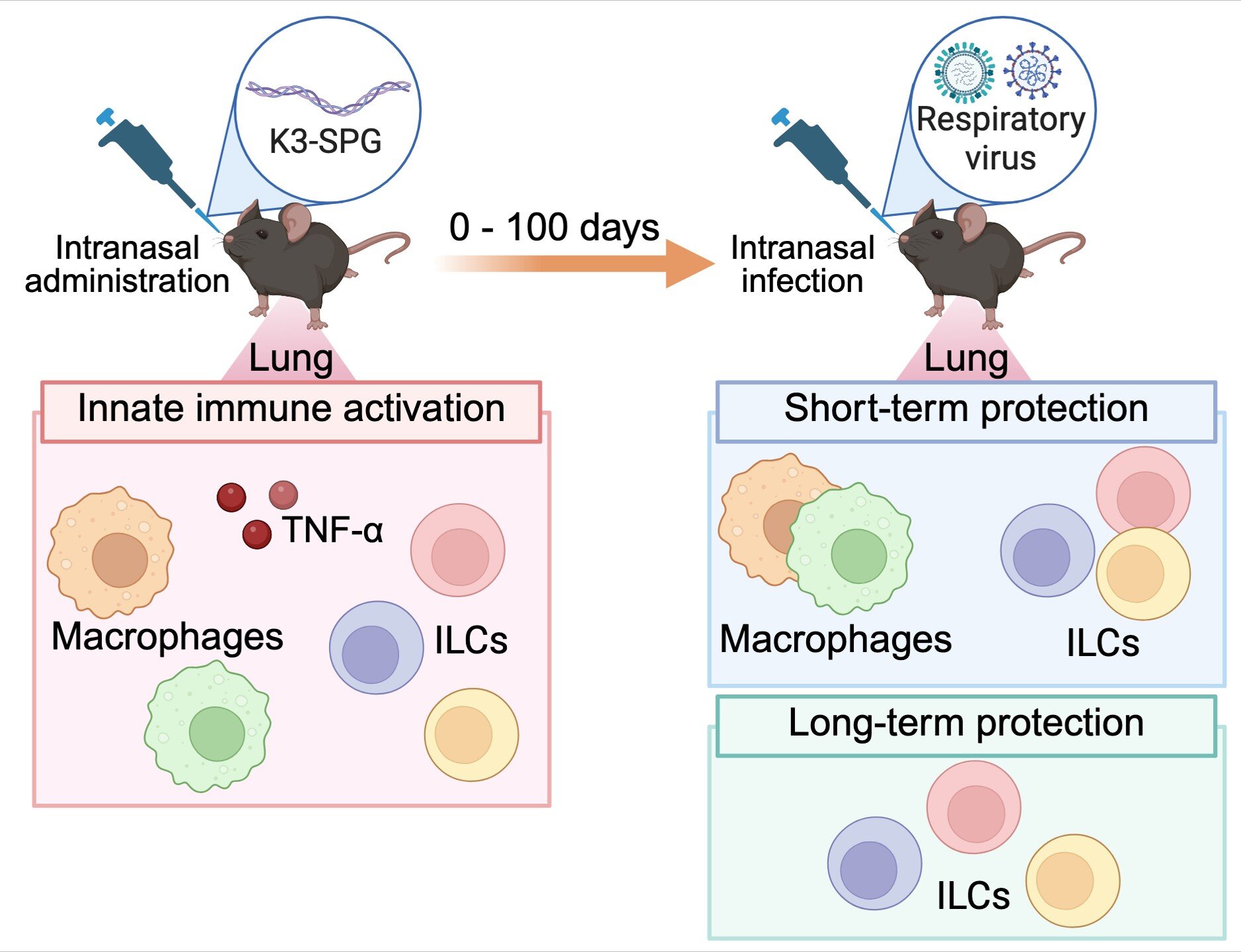
One possible answer lies in innate immunity, the body's first line of defense. Unlike adaptive immunity, which learns to recognize specific targets, innate immunity can respond to threats without prior exposure. Some studies have shown that certain stimuli can leave innate immune cells more responsive through a phenomenon called trained immunity. However, questions remain about how long this protection can last and which cells are responsible for maintaining it in the respiratory tract.
To bridge these knowledge gaps, a research team led by professor Ken Ishii from the Division of Vaccine Science, Department of Microbiology and Immunology at The Institute of Medical Science, The University of Tokyo, Japan, investigated how the vaccine adjuvant K3-SPG modulates innate immunity. The study was co-authored by Ph.D. candidate Asuka Joy Tobuse of The University of Tokyo and associate project scientist Kouji Kobiyama of the University of California San Diego, U.S., formerly a member of Ishii's laboratory at The University of Tokyo.
K3-SPG is a nanosized adjuvant that combines a short piece of synthetic DNA called CpG oligodeoxynucleotide, which activates the immune sensor toll-like receptor 9 (TLR9), with a β-glucan called schizophyllan.
Source link





