
This article has been reviewed according to Science X's editorial process and policies. Editors have highlighted the following attributes while ensuring the content's credibility:
House dust can contain chemical and biological components, including phthalates, flame retardants, allergens, endotoxins and microorganisms. Because pregnant women spend time indoors, household environmental conditions during pregnancy may be relevant to child development.
Earlier research linked maternal cleaning behaviors with infant development up to 12 months, but evidence beyond the first year was limited. The researchers therefore examined whether these behaviors were associated with developmental screening outcomes from 18 months to 3 years of age.
To address this gap, a research team led by specially appointed assistant professor Kanako Shimada of the Toyama Regional Center for JECS at the University of Toyama, Japan, conducted the study in collaboration with researchers from the university's Department of Public Health.
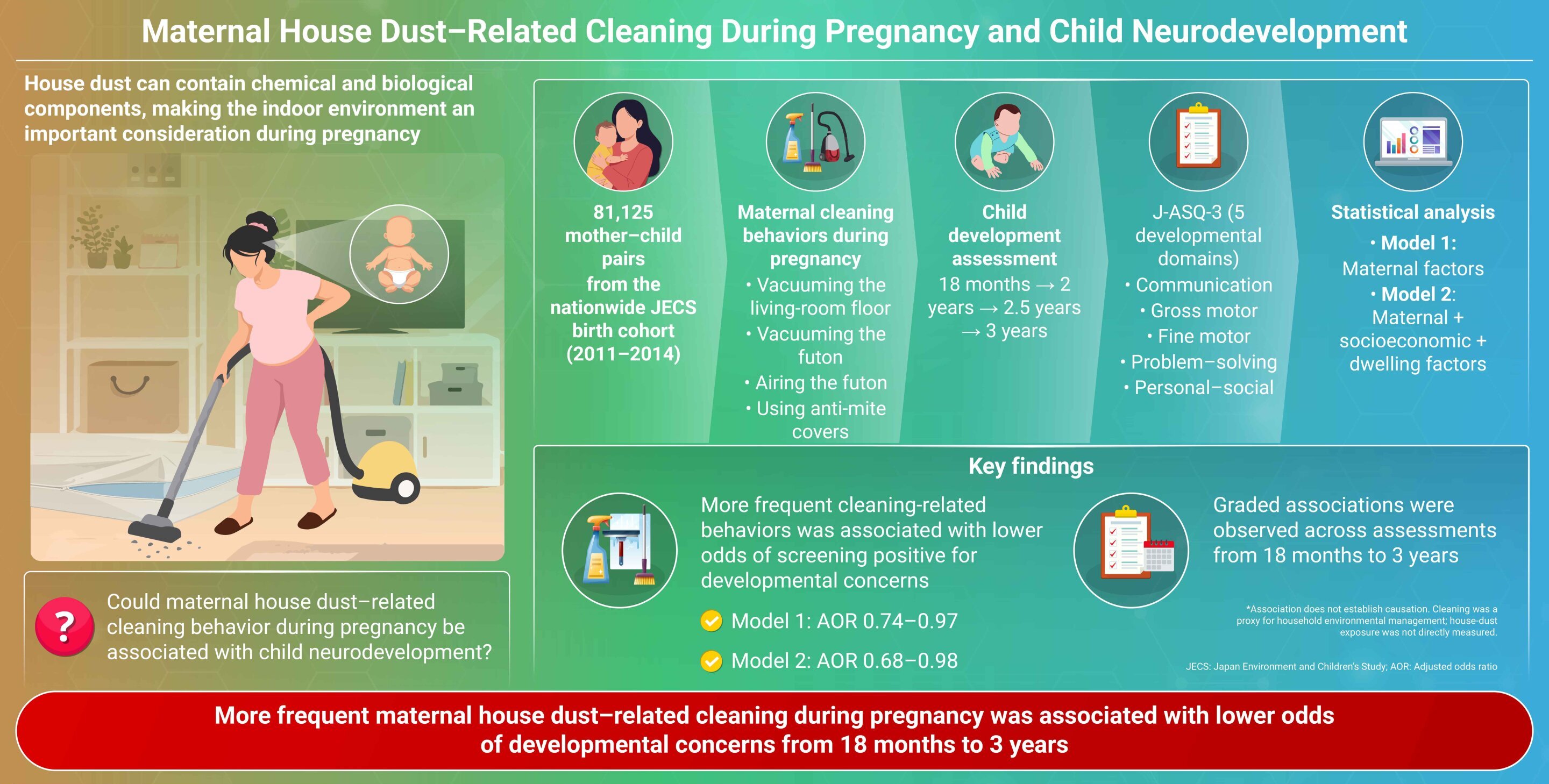
They analyzed data from 81,125 mother–child pairs participating in the Japan Environment and Children's Study, a nationwide birth cohort.
Mothers reported how often they vacuumed living room floors and futons and aired futons during pregnancy, as well as whether they used anti-mite covers for their futons or bedding. Child development was assessed at 1.5, 2.0, 2.5 and 3.0 years using the Japanese Ages and Stages Questionnaires, Third Edition (J-ASQ-3), covering five developmental domains: communication, gross motor, fine motor, problem-solving and personal–social.
Generalized linear models were used to estimate adjusted odds ratios (AORs); Model 1 accounted for maternal factors, and Model 2 additionally accounted for socioeconomic and dwelling environment factors.
Source link





