This article has been reviewed according to Science X's editorial process and policies. Editors have highlighted the following attributes while ensuring the content's credibility:
Hallucinations in Parkinson's disease are frequent. They start with visual illusions and sensations of someone being nearby or passing by one's body (minor hallucinations) and develop into complex visual hallucinations as the disease progresses toward dementia.
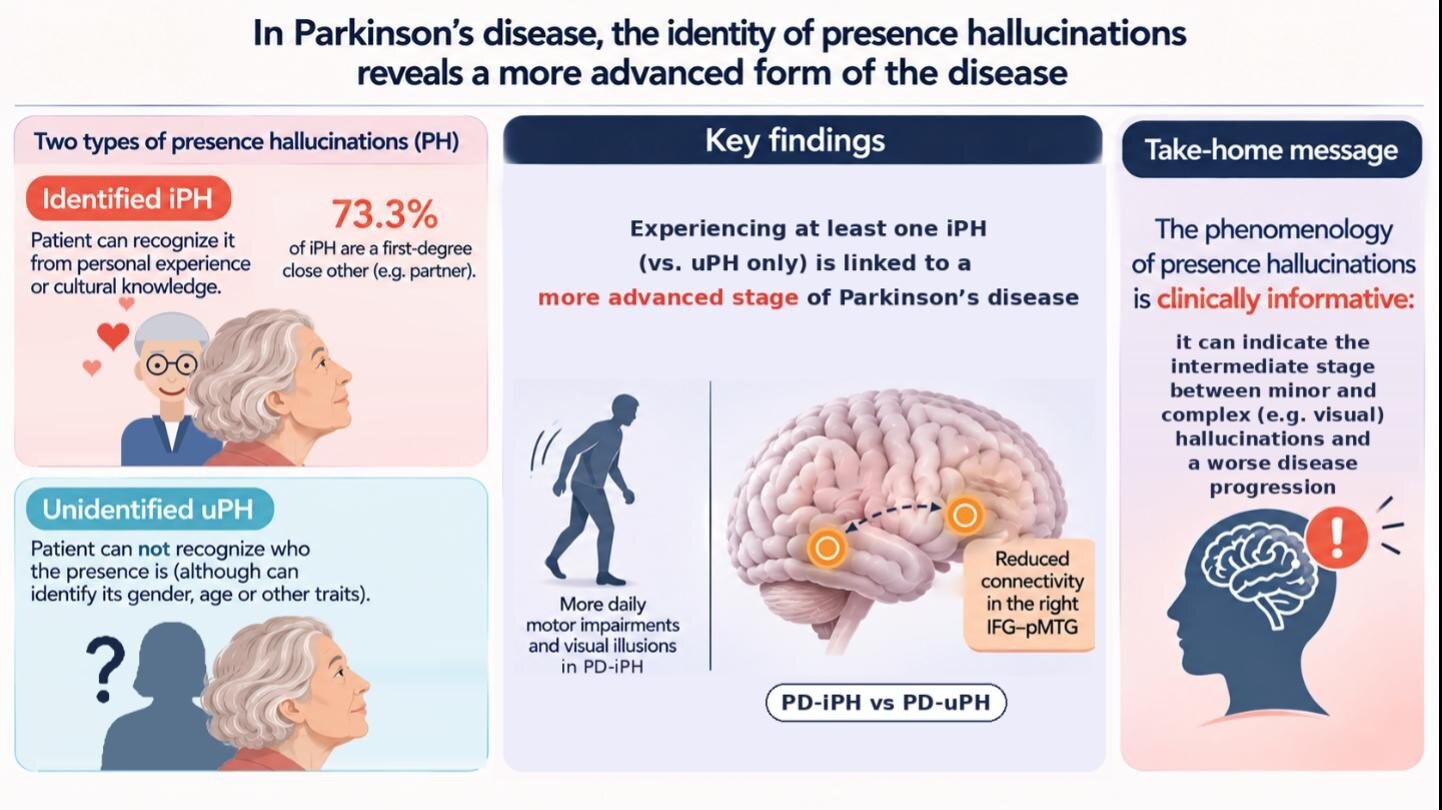
In a new study published in the journal npj Parkinson's disease, a team led by Neza Vehar investigated this progression in complexity for presence hallucinations (PH). These hallucinations of invisible human presences can occur with different identities, ranging from merely having a gender or age, all the way to being experienced as a previously known person and identified as such by patients.
Comparing Parkinson's disease patients who can and cannot identify their PH, the research team found that those experiencing identifiable PH (iPH), mostly perceived as the patient's closest other, also have more movement impairments in daily life, are at a more advanced stage of the disease and experience more visual illusions, even though they are otherwise similar in age, disease duration and dopaminergic medication.
Moreover, compared to the group experiencing unidentified PH (uPH), patients with iPH displayed functional disconnection between two cortical regions (the right inferior frontal gyrus and the posterior superior temporal sulcus area), previously associated with psychosis and cognitive decline. The study establishes iPH as an intermediate stage of hallucination complexity indicating a worse disease trajectory and reveals impaired social brain mechanisms in Parkinson's disease, involving posterior and frontal brain circuits.
Source link