This article has been reviewed according to Science X's editorial process and policies. Editors have highlighted the following attributes while ensuring the content's credibility:
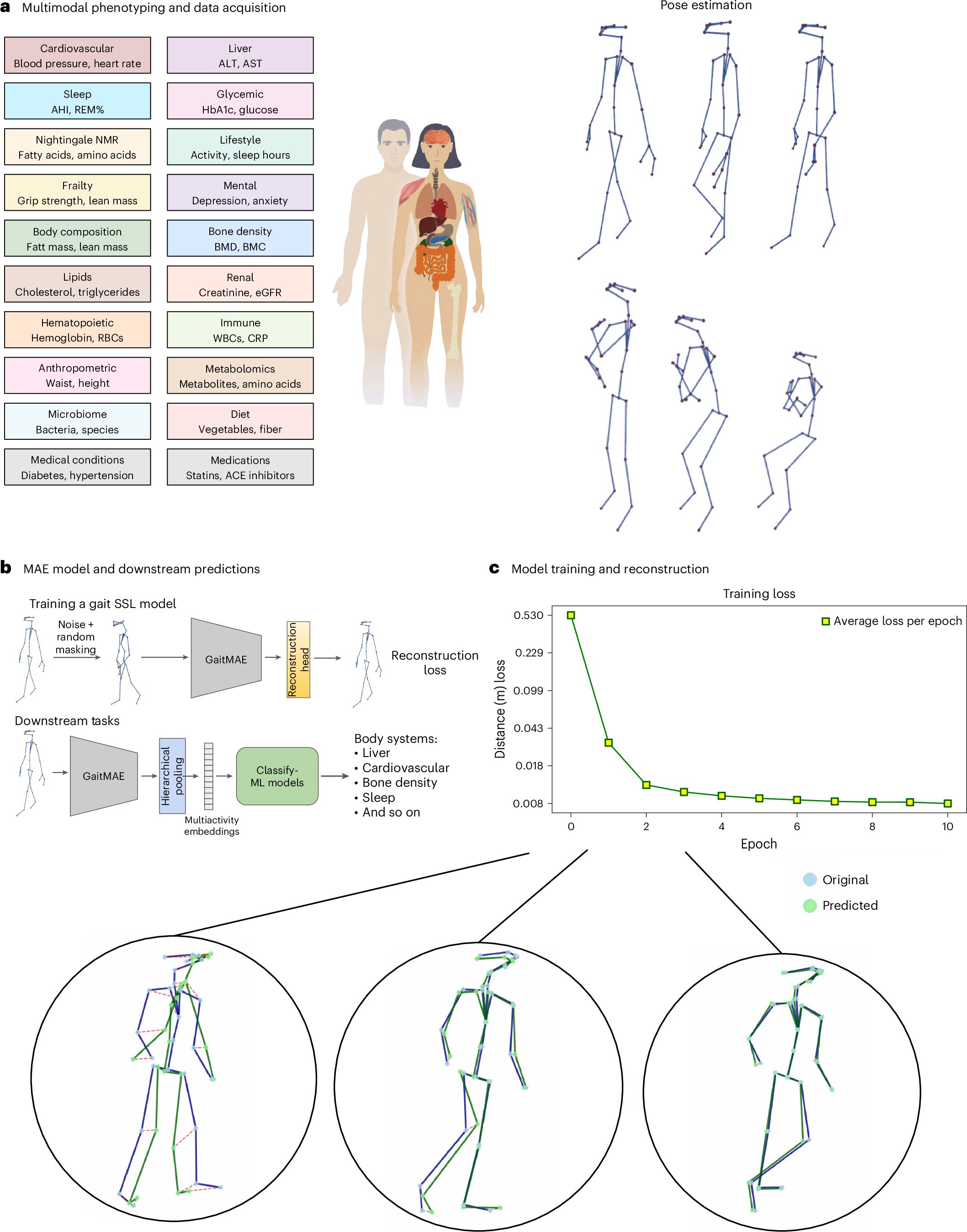
Newton Tech, a developer of AI-powered movement intelligence technology for clinical research, has published a new study it co-authored in Nature Medicine showing that artificial intelligence can reveal extensive health information encoded in subtle patterns of human movement. In 3,328 adults, the model identified significant associations with 1,887 of 3,210 health measures spanning 18 body systems, from blood tests and liver imaging to sleep, mental health and clinical diagnoses.
The paper is titled "A Gait Foundation Model Predicts Multi-System Health Phenotypes from 3D Skeletal Motion."
For pharmaceutical and biotechnology companies, the findings have immediate relevance to clinical development. Traditional functional assessments often reduce movement to a single number, such as the time required to walk a set distance.
Newton Tech is applying AI-powered movement analysis in clinical trials to measure dozens of dimensions of how a patient moves, from joint-level coordination and balance strategy to mechanical effort and compensation, giving sponsors a more sensitive view of treatment response and disease progression than conventional assessments alone may provide.
Using Newton Tech's camera-based Movement Lab technology, researchers collected three-dimensional movement data during five standardized motor assessments. The research team analyzed the data using an AI foundation model capable of identifying complex patterns in movement that conventional gait measurements, such as walking speed and stride length, often miss.
The study, whose lead author is Adam Gabet, was conducted through the Human Phenotype Project, a large-scale research cohort.
Source link