
This article has been reviewed according to Science X's editorial process and policies. Editors have highlighted the following attributes while ensuring the content's credibility:
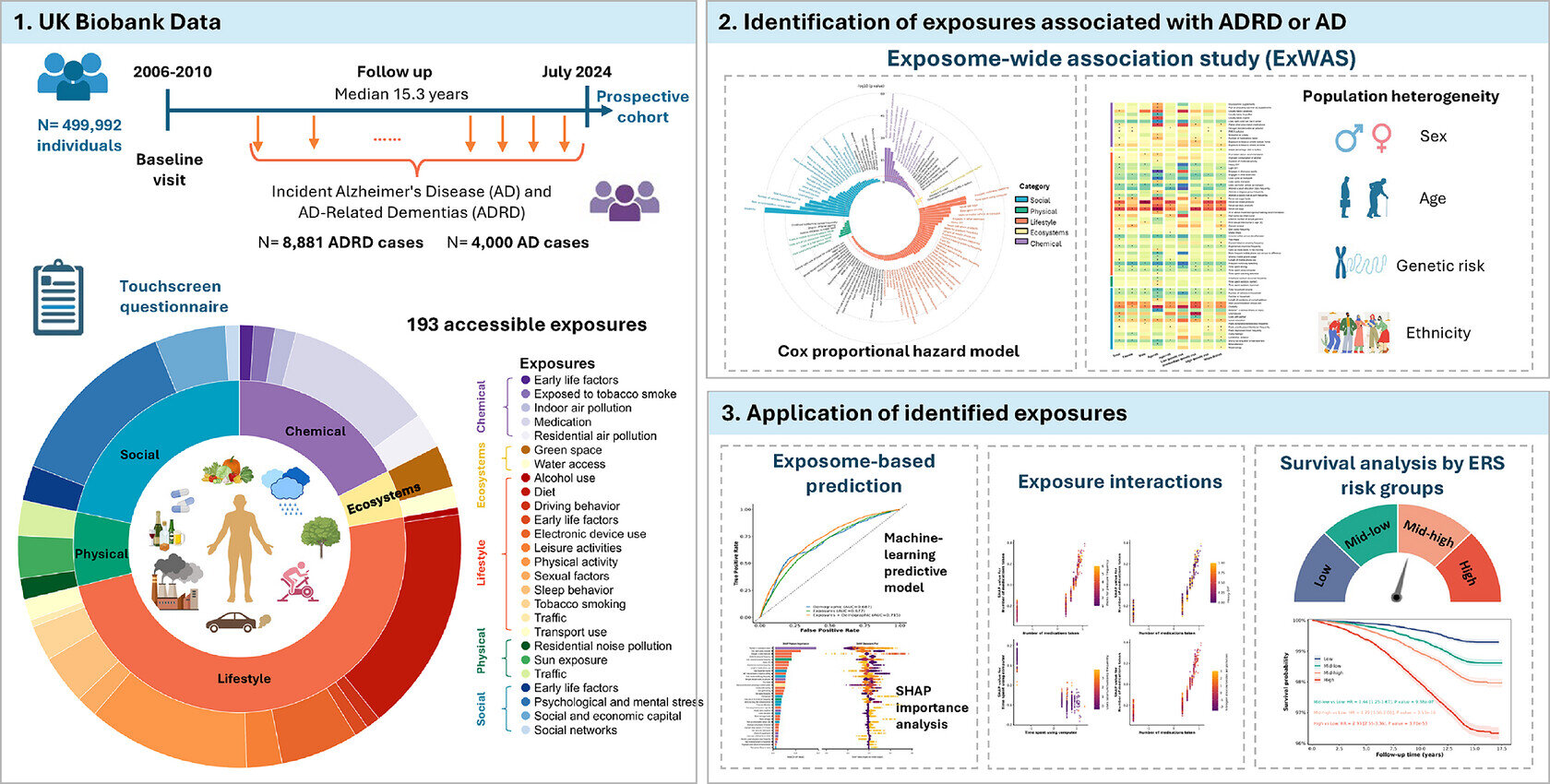
Amid the increasing prevalence of Alzheimer's disease and related dementias (ADRD), a team led by researchers from Harvard Medical School and Harvard T.H. Chan School of Public Health has conducted what they describe as the most extensive systematic evaluation to date of associations between ADRD and nearly 200 environmental exposures—from pollution to diet to social connections.
The researchers also produced a first-of-its-kind exposomic risk score that can help predict people's risk of these diseases and could therefore contribute to prevention strategies.
Co-senior authors Chirag Patel, associate professor of biomedical informatics in the Blavatnik Institute at HMS, and Peng Gao, assistant professor of environmental health and exposomics at Harvard Chan School, study the exposome—all the environmental exposures people face across their lifespan—and how these exposures affect health.
Although genetic factors are involved in ADRD, most cases cannot be attributed to genetics alone, and previous research has suggested that environmental exposures also play a significant role.
3 years in the UK Biobank —a database that collects health, genetic and lifestyle data over time. Patel, Gao and colleagues conducted an exposome-wide association study examining 193 exposures across five domains: chemical, such as air pollutants and medications; physical, such as noise; lifestyle, such as diet, physical activity and sleep; social, such as education and socioeconomic status; and ecosystems, such as access to green space.
Source link





