This article has been reviewed according to Science X's editorial process and policies. Editors have highlighted the following attributes while ensuring the content's credibility:
Inflammatory bowel disease damages the lining that separates the gut's contents from the rest of the body. Calming the inflammation is only part of the treatment challenge, however—that protective barrier also needs to heal.
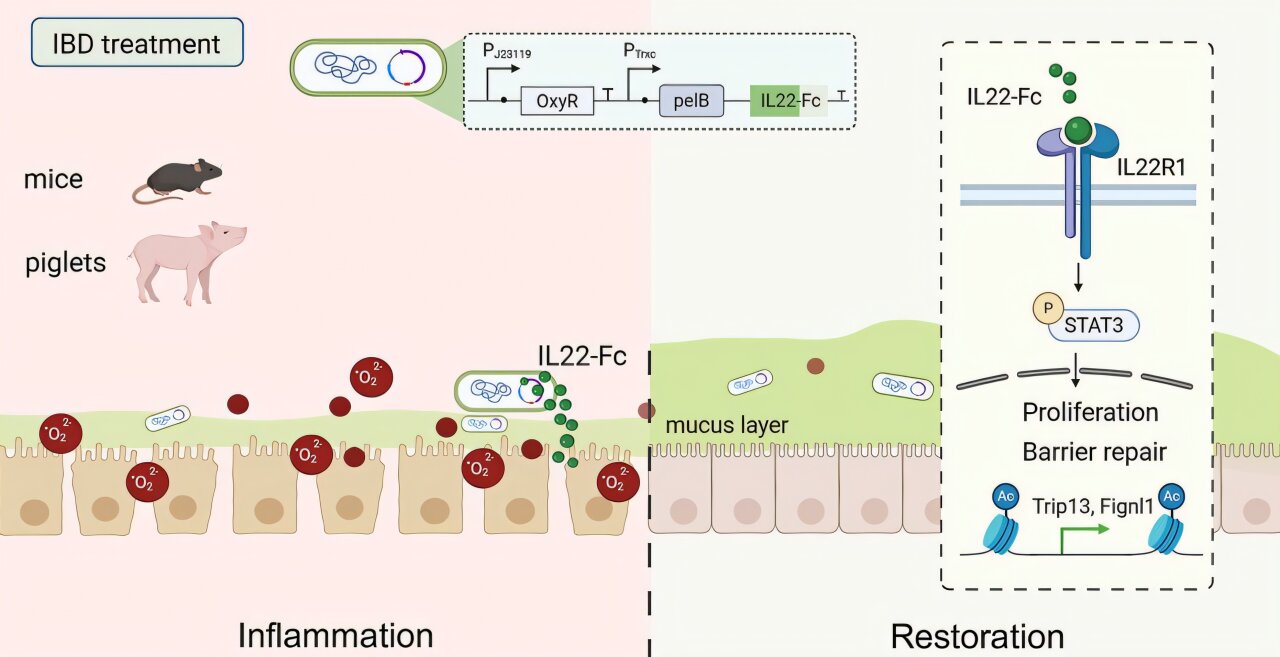
Researchers have engineered a probiotic bacterium that uses the chemical signs of inflammation to switch on production of a protein that encourages intestinal repair. Given orally to mice with chemically induced colitis, the bacteria both reduced tissue damage and promoted recovery of the gut lining.
Yu Zhao of Hunan University in China and colleagues describe their approach in the journal Cell Reports. Their experiments connect two promising treatment pathways of detecting an inflamed gut and delivering a repair signal in response.
The team started with Escherichia coli Nissle 1917, a bacterial strain used as a probiotic. They added a genetic switch that is responsive to reactive oxygen species, which are chemicals that accumulate in inflamed intestinal tissue.
To check whether the bacteria could detect inflammation, the researchers connected the switch to instructions for making a light-generating enzyme. After mice received the bacteria orally, laboratory measurements of their stool showed stronger light signals as inflammation developed.
The signal was associated with the severity of tissue damage, rather than simply with the number of bacteria present. That suggested the microbes could report changes in the gut's condition.
The team also mixed the sensor bacteria with stool samples from eight people with inflammatory bowel disease and eight healthy volunteers.
Source link