
This article has been reviewed according to Science X's editorial process and policies. Editors have highlighted the following attributes while ensuring the content's credibility:
A research team has developed a combination immunotherapy that uses an electrical ablation technique to enhance the efficacy of immune cell therapy against liver cancer.
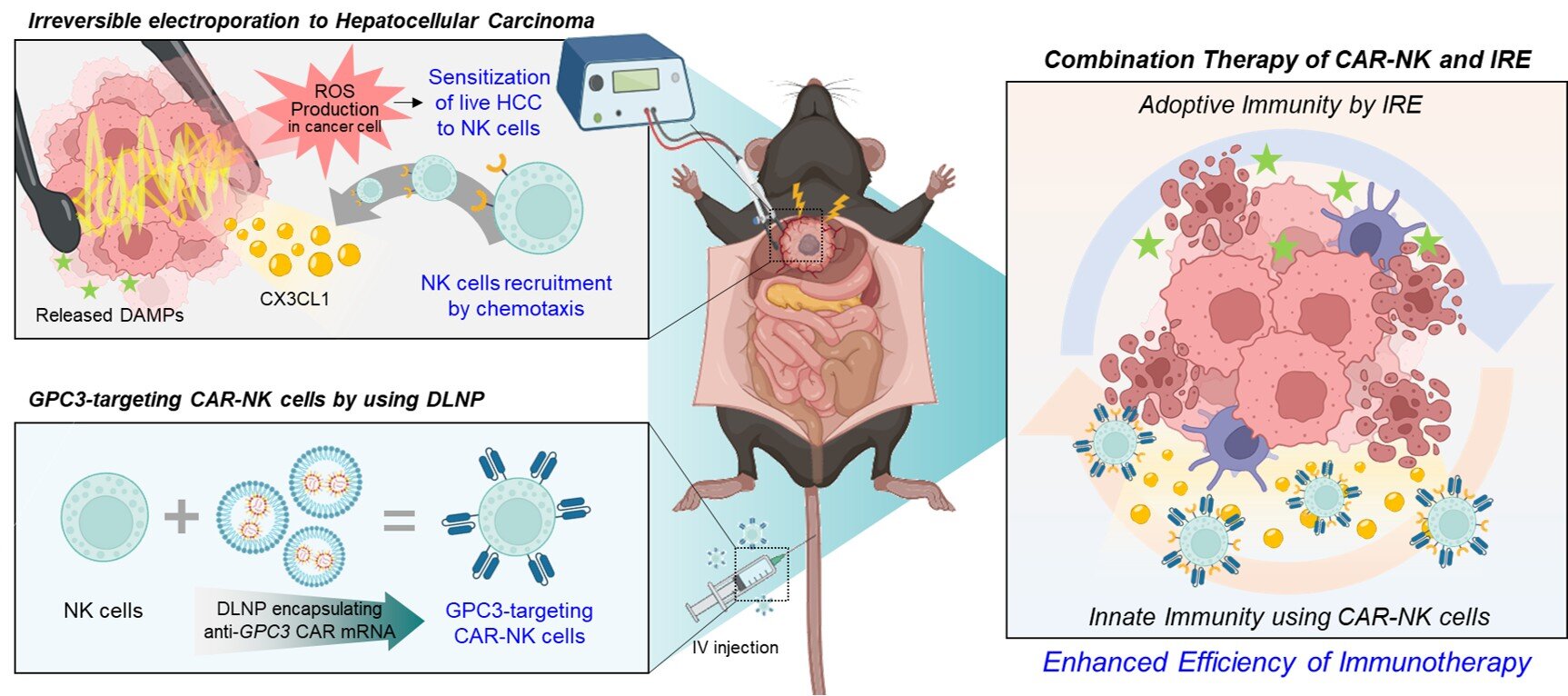
The team, led by Professor Wooram Park of the Department of Integrative Biotechnology at Sungkyunkwan University (SKKU), used irreversible electroporation (IRE) to reshape the immunosuppressive tumor microenvironment in liver cancer and enhance the anticancer activity of chimeric antigen receptor natural killer (CAR-NK) cells.
The study is published in the journal Signal Transduction and Targeted Therapy.
The team also identified the key molecular mechanisms underlying this therapeutic effect. Joo Dong Park and Ha Eun Shin, researchers in Park's group, served as co-first authors of the study.
Conventional immune cell–based cancer therapies often suffer from limited infiltration of therapeutic cells into tumors and reduced efficacy due to the immunosuppressive tumor microenvironment. Hepatocellular carcinoma, in particular, has a highly immunosuppressive environment, making it difficult to achieve sufficient therapeutic effects with CAR-NK cell therapy alone.
To overcome this limitation, the research team developed an approach using IRE, a clinically approved nonthermal ablation technique, to remodel the tumor microenvironment.
IRE destroys tumor cells using high-voltage pulsed electric fields. This process induces the release of damage-associated molecular patterns (DAMPs) and chemokines—chemical signaling proteins that attract immune cells—thereby transforming the tumor microenvironment into one that is more favorable for NK cell activity.
The researchers found that chemokine levels within tumors increased significantly after IRE treatment, leading to the early recruitment of NK cells.
Source link





