
This article has been reviewed according to Science X's editorial process and policies. Editors have highlighted the following attributes while ensuring the content's credibility:
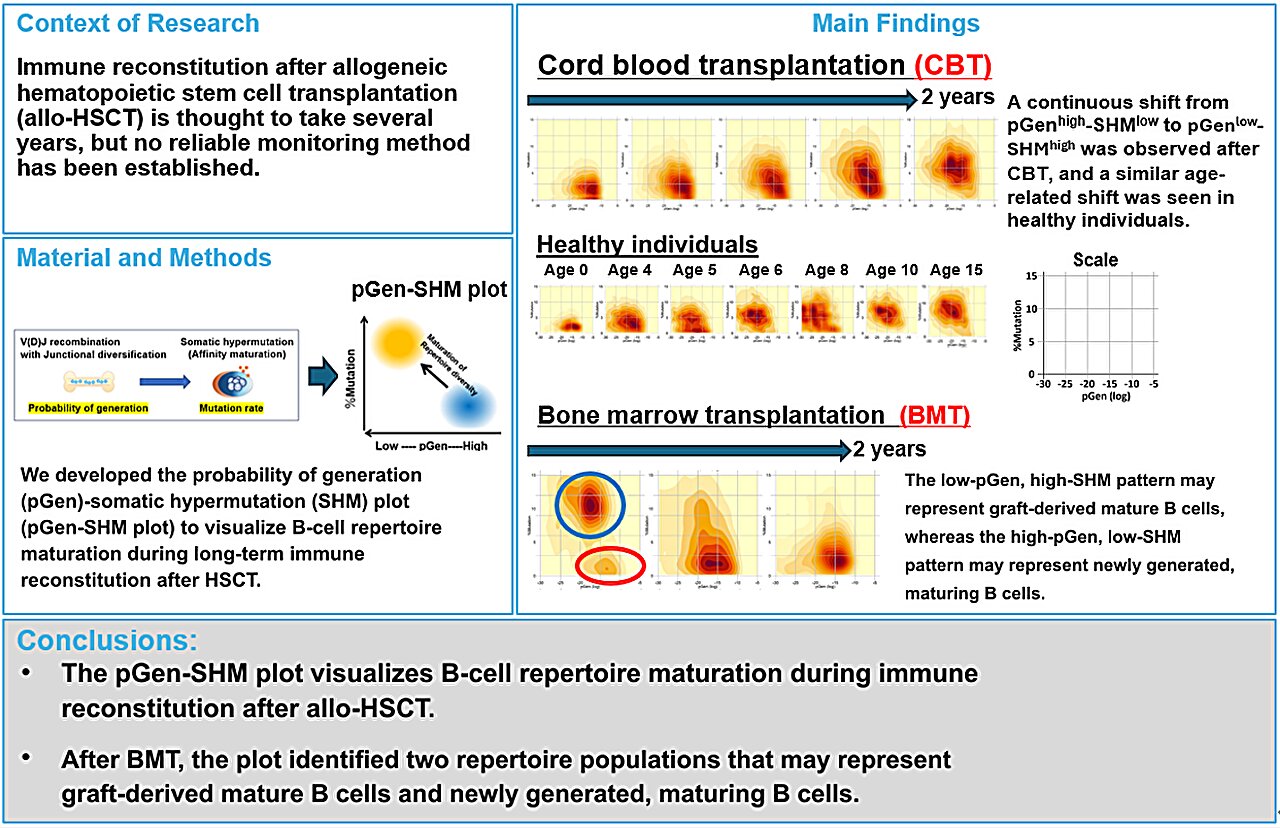
A research team led by associate professors Yohei Funakoshi and Kimikazu Yakushijin and Professor Hironobu Minami of the Division of Medical Oncology/Hematology at Kobe University Hospital, together with Associate Professor Goh Ohji of the Division of Infectious Disease Therapeutics and Takaji Matsutani of Anymics Inc., has developed the pGen-SHM plot.
The method combines the generation probability (pGen) of individual B-cell receptor (BCR) sequences with somatic hypermutation (SHM) associated with antigen-driven maturation. This enables the visualization and objective assessment of the maturation of the BCR repertoire after allogeneic hematopoietic stem cell transplantation (allo-HSCT).
After cord blood transplantation (CBT), an initially immature repertoire shifted over approximately two years toward a pattern resembling that of healthy adults.
By contrast, the plots showed two distinct populations early after bone marrow transplantation (BMT): one with low pGen and high SHM and a second with high pGen and low SHM. These patterns were consistent with contributions from mature B cells in the graft and from maturing B cells newly generated from hematopoietic stem cells.
The pGen-SHM plot visualized features that were not apparent from conventional diversity indices. With further clinical validation, it may provide a new way to monitor humoral immune reconstitution after transplantation.
The findings were published online in Blood Immunology & Cellular Therapy.
In allogeneic hematopoietic stem cell transplantation, immunity acquired through previous vaccination or infection may be substantially reduced or lost.
Source link





