
This article has been reviewed according to Science X's editorial process and policies. Editors have highlighted the following attributes while ensuring the content's credibility:
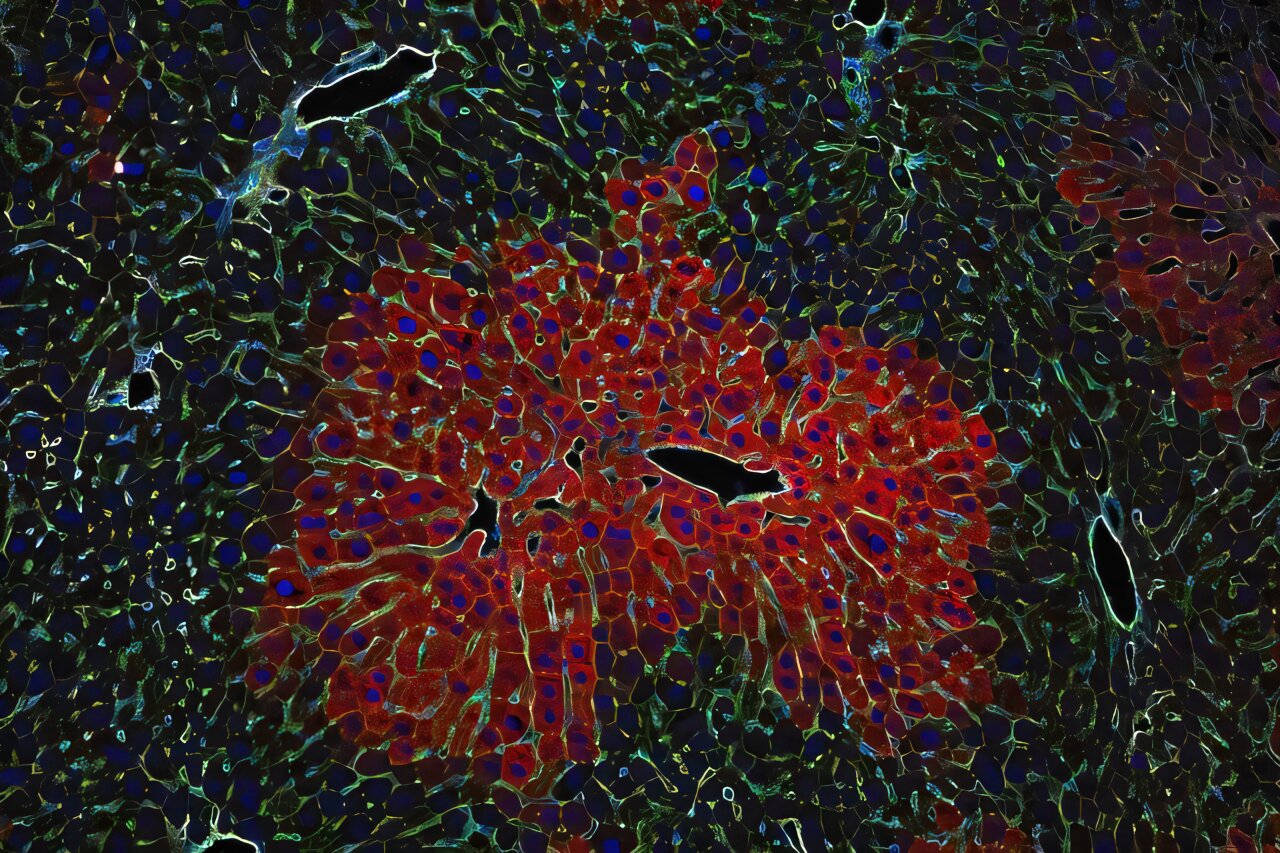
The liver is organized into distinct zones in which liver cells perform different functions. The blood vessels of the liver play an important role in this spatial organization: the endothelial cells lining the vessels provide signals that instruct neighboring liver cells and help determine their function. But how do endothelial cells know which signals to produce?
Scientists from the Medical Faculty Mannheim of Heidelberg University and the German Cancer Research Center (DKFZ) have now identified a fundamental mechanism: blood flow and the biomechanical forces it generates determine which molecular program endothelial cells activate. Through the Wnt signaling pathway, they regulate the function of neighboring liver cells. The findings have been published in Nature Communications.
The liver performs a wide range of essential functions—from processing and storing nutrients to detoxifying the body and producing important blood proteins. Not all liver cells perform these tasks in the same way. Depending on where they are located within a liver lobule, different metabolic programs are active. This so-called metabolic zonation allows the liver to organize its different functions spatially.
The blood vessels of the liver play an important role in this spatial organization. Their endothelial cells, which line the smallest blood vessels—known as liver sinusoids—release so-called angiocrine signals to neighboring liver cells. In this way, endothelial cells can directly influence the function of the surrounding liver cells. Yet one fundamental question remained unanswered: How do endothelial cells know which signals to produce?
Source link





