
This article has been reviewed according to Science X's editorial process and policies. Editors have highlighted the following attributes while ensuring the content's credibility:
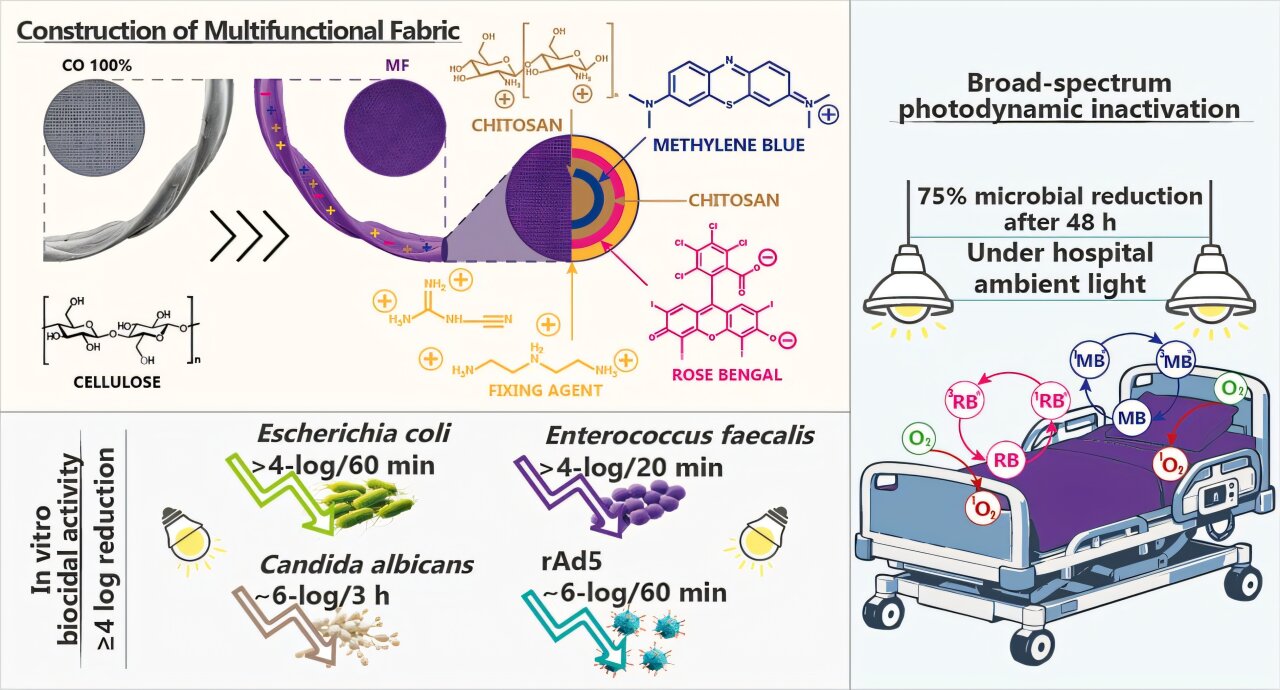
A team has developed a new self-disinfecting cotton fabric capable of eliminating bacteria, fungi and viruses in hospital settings using visible light.
"The material incorporates two photoactive compounds that, when exposed to light, generate a highly reactive form of oxygen that damages the microorganisms adhering to the fabric, thereby eliminating them," explains author Alberto Blázquez-Moraleja.
The team includes researchers from the Alcoy campus of the Universitat Politècnica de València (UPV), the Research Institute for Chemical Technology (ITQ, CSIC-UPV), the Research Institute for Mediterranean Agroforestry (IAM UPV) and the Joint Research Unit between the UPV and the Health Research Institute at La Fe Hospital in Valencia (UPV-IISLaFe).
"We aim to develop fabrics capable of reducing the presence of microorganisms such as bacteria, fungi and viruses in hospitals and other health care settings, thereby mitigating some of the problems associated with conventional antimicrobials, such as a loss of efficacy with use or washing, or the promotion of resistant microorganisms. And that is precisely what we have achieved in this study," says Marilés Bonet of the Textile and Paper Engineering Department at the UPV's Alcoy campus.
The study has been published in ACS Applied Materials & Interfaces.
In laboratory tests, the fabric completely inactivated Escherichia coli within 60 minutes and Enterococcus faecalis within 20 minutes when exposed to light. It also achieved a reduction in Candida albicans within three hours.
Source link





