VRChat now offers native SDK-level Face Tracking support for avatars in the Open Beta client and Avatars SDK beta.
VRChat has technically supported Eye and Face Tracking for years over OSC (Open Sound Control) and the community-made VRCFaceTracking (VRCFT) app. However, avatars did not natively support full facial tracking, and instead needed to be configured with add-ons. Without them, avatars could only natively use Eye Tracking data for basic gaze and eyelid movement.
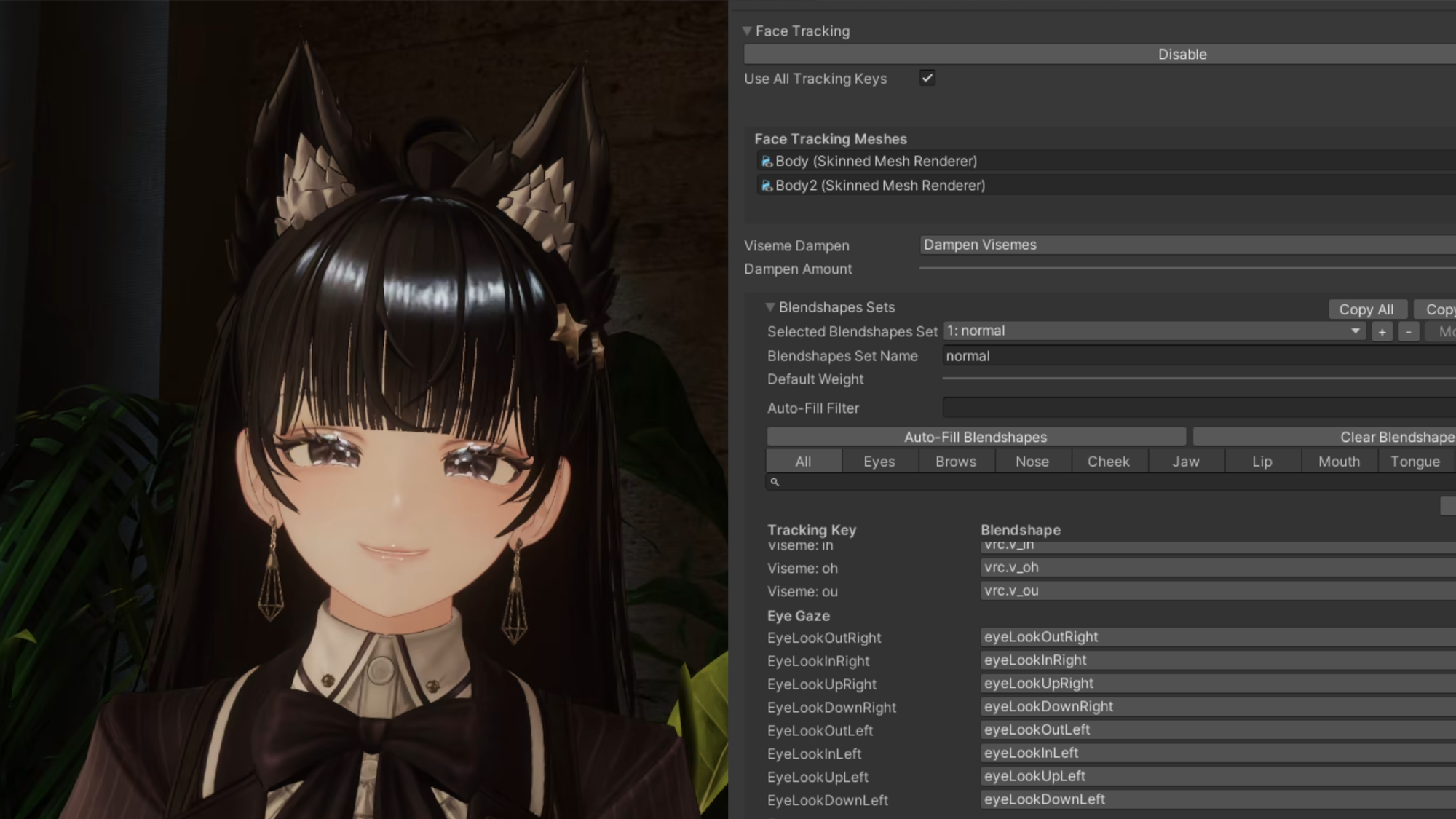
Now, VRChat's latest Open Beta client on Steam and Avatars SDK Version 3.10.6-beta.1 and higher bring support for SDK-level authoring of Face Tracking. Initially described as "High Fidelity Face Tracking," the feature allows creators to set up facial expressions for an avatar via a new dedicated section in the Avatar Descriptor component.
Native Face Tracking on the avatar Lumina from Extension Clothing with Hash's integration package.
The new system maps facial expressions to blendshapes and animator parameters, supports the Unified Expressions standard from VRCFT, and integrates with VRChat's audio-driven visemes, eye look, and eyelids. It does not currently support Blended Shapes or Simplified Parameters.
Even further, the system allows for network-synced Face Tracking without contributing to the avatar's synced parameter budget. On paper, this should mean a reduced synced parameter load for the avatar, more visually consistent facial expressions for other users, and better performance.
VRChat's native Face Tracking supports OSC methods like VRCFT (in its latest beta release on Steam ) as well as VRChat's Selfie Expression feature, which allows you to mirror facial expressions to an avatar on desktop PC and Android via a webcam or front-facing camera.
Source link