Hindi cinema has long looked to Hollywood as a benchmark for big-screen action; much of its 21st century style, for instance, was inspired by Mission: Impossible 2. Ramayana: Rise of a Legend re-imagines the resplendent Hindu epic as a CGI-laden blockbuster at a time when the Marvel Cinematic Universe has become the de facto touchstone for big-budget adaptations. In that vein, Nitesh Tiwari’s undertaking does, in fact, resemble a Marvel movie. Unfortunately, that Marvel movie happens to be Thor: Love and Thunder, a much-derided film whose floating head VFX had to be famously reworked.
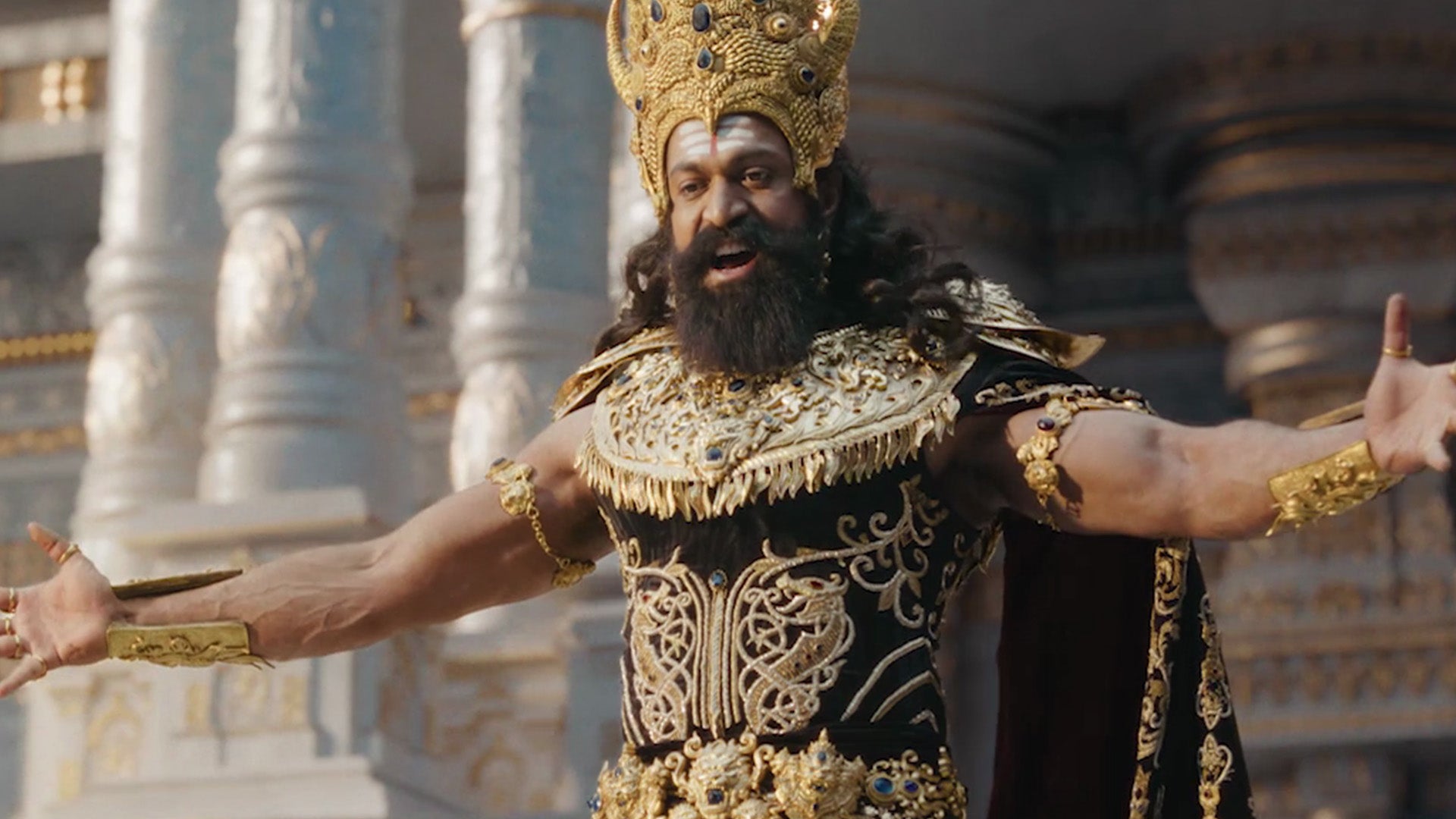
This resemblance takes hold in an early scene, in which the epic’s antagonist, Ravana (charismatic Toxic star Yash), prays atop a cliff to the creator-god Brahma, whose countenance takes the form of a disembodied constellation with an overly-expressive digital mouth. This excess fluidity is owed, in part, to the movie’s uncanny English dub, which was shown to press in the United States in lieu of the original Hindi version (which happens to be 18 minutes longer than this 162-minute cut). Rather than traditional dubbing, the filmmakers developed their own in-house Generative A.I. technology (fittingly called Brahma A.I.) to sync up the characters’ lips to the flowery English dialogue. Some are calling it the future of cinema, but in its current incarnation, the result resembles exaggerated mouth movements superimposed on still images for comedy sketches, à la The Annoying Orange.
This effect is befitting of such a robotic adaptation, one which briefly threatens to interrogate the several millennia-old text of the title (in the vein of recent Thai drama The Burning Giants , which critiques the violence at the heart of national myths) before locking itself into a didactic approach.
Source link