
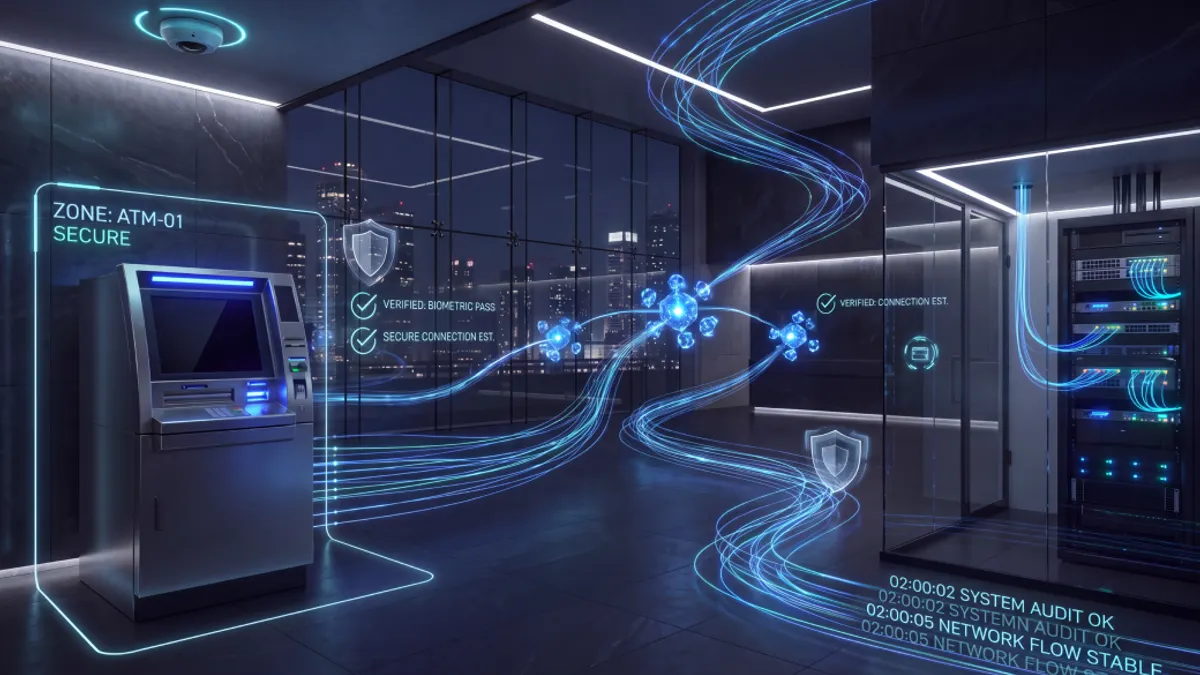
It's 2 a.m. and the branch is empty. There’s a lobby ATM humming quietly, a security camera blinking in the corner, and somewhere in the cloud, an AI agent is finishing a batch of overnight fraud scores. All of them are inside the bank's trust boundary, but each is managed as an isolated security problem.
That fragmentation is no longer sustainable. Protecting every device, login, and autonomous script requires something different from standalone, bolted-on cybersecurity. Banks need one architecture with security and visibility built into every layer. Resilience comes from unifying tools, not adding more of them onto existing architectures.
Devices like ATMs, badge readers, and Internet of Things (IoT) devices lack the memory capacity and proper operating system (OS) to run powerful security features like endpoint detection and response (EDR) and host-based firewalls. It’s a vulnerability that banks have lived with for years. Now add the complexity of safeguarding AI agents, which access systems and execute application programming interface (API) calls without a human in the loop. Their "unlisted" entry points add new openings for attackers.
It's no wonder 79% of financial services respondents say AI has already expanded their network's attack surface and 85% have already added security controls, specifically for AI workloads1. That's encouraging, but adding more controls to an old architecture is like adding extra locks to a house with no foundation. It buys time, not resilience.
Routing all traffic through a centralized inspection appliance introduces latency that breaks apps like real-time fraud detection and creates single points of failure.
Source link





