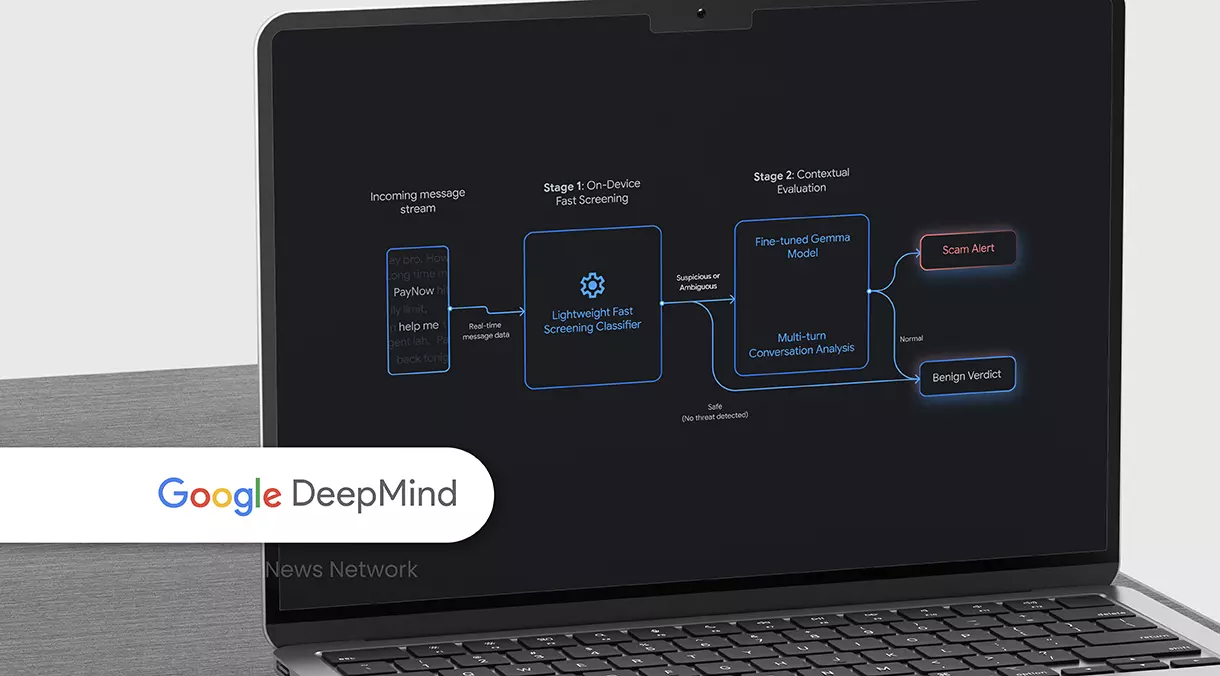
Google DeepMind and the Government Technology Agency of Singapore (GovTech) have developed an on-device AI model designed to detect scams in smartphone conversations without sending messages to the cloud.
Presented at Singapore International Cyber Week (SICW 2026), the project forms part of Google’s National AI Partnership with the Singapore Government.
Scams account for more than half of Singapore’s reported crimes, with losses exceeding S$4 billion since 2019.
Scammers have increasingly turned to social engineering, using convincing conversations to manipulate victims into transferring money. Such tactics now account for up to 80% of scam losses, according to Google DeepMind.
Built on Google’s lightweight Gemma model, the system has been fine-tuned on local scam conversations involving impersonations of public institutions, banks and local figures, alongside emerging regional schemes.
A lightweight classifier first screens incoming messages for potential threats. When it flags suspicious content, the fine-tuned Gemma model examines a larger portion of the conversation to confirm the threat or rule out a false alarm.
If manipulative patterns are detected, the system is designed to display a real-time warning advising users to exercise caution before sharing sensitive information or transferring money.
Unlike cloud-based detection systems, the model processes conversations directly on smartphones, allowing scam analysis without sending messages to external servers.
He said the collaboration aims to identify targeted local scams while keeping personal communications private.
Google DeepMind and GovTech plan to introduce the model gradually through applications developed in partnership with the Singapore Government.
Both organisations said neither Google nor the Singapore Government would be able to access users’ conversations through the model’s deployment.
Source link