Complete the form to unlock this article and enjoy unlimited free access to all PYMNTS content — no additional logins required.
Companies have spent the past several years making it possible for employees to safely use artificial intelligence to retrieve information, summarize documents and generate recommendations. Agentic AI is turning that operating model on its head because the software is no longer simply answering questions. It can write into systems, make decisions and execute transactions.
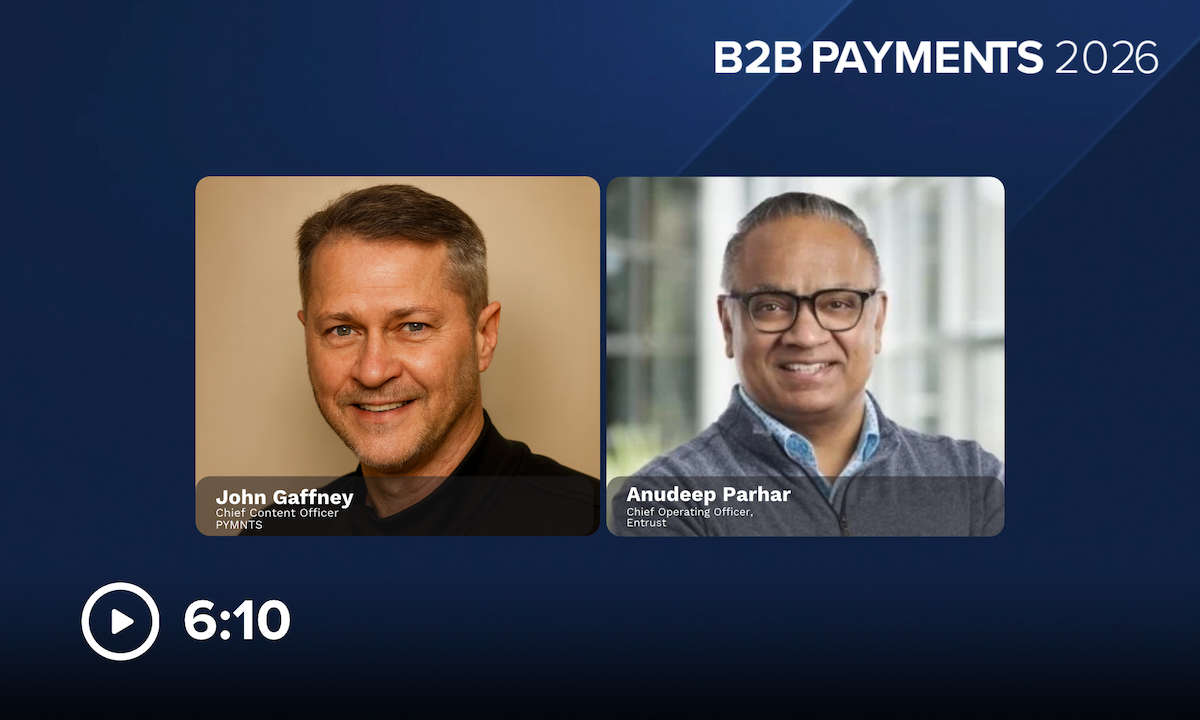
“The two key goals of agentic are around productivity of your workers and your staff, and helping the organization grow,” Entrust Chief Operating Officer Anudeep Parhar told PYMNTS during the discussion “Stopping B2B Fraud Before AI Moves the Money,” a PYMNTS B2B Payments 2026 event session.
Organizations eventually could have “thousands of agents, millions of agents” acting for customers and employees, Parhar said.
The catch is that extracting those gains requires enterprises to delegate authority, which is more sensitive than access to data. For agentic commerce to successfully scale, the operational architecture surrounding those agents must answer three questions at machine speed. Was the action permitted? Did it reflect the intended objective? Who was ultimately responsible for authorizing it?
Agentic AI, it turns out, is becoming as much an identity and authorization problem as an AI problem.
One useful way to understand the emerging enterprise AI stack is to stop dividing applications into “AI” and “non-AI” and instead categorize them by what they are allowed to do.
“There are existing policies in place which need to be implemented at agentic scale in an agent environment,” Parhar said.
Source link