
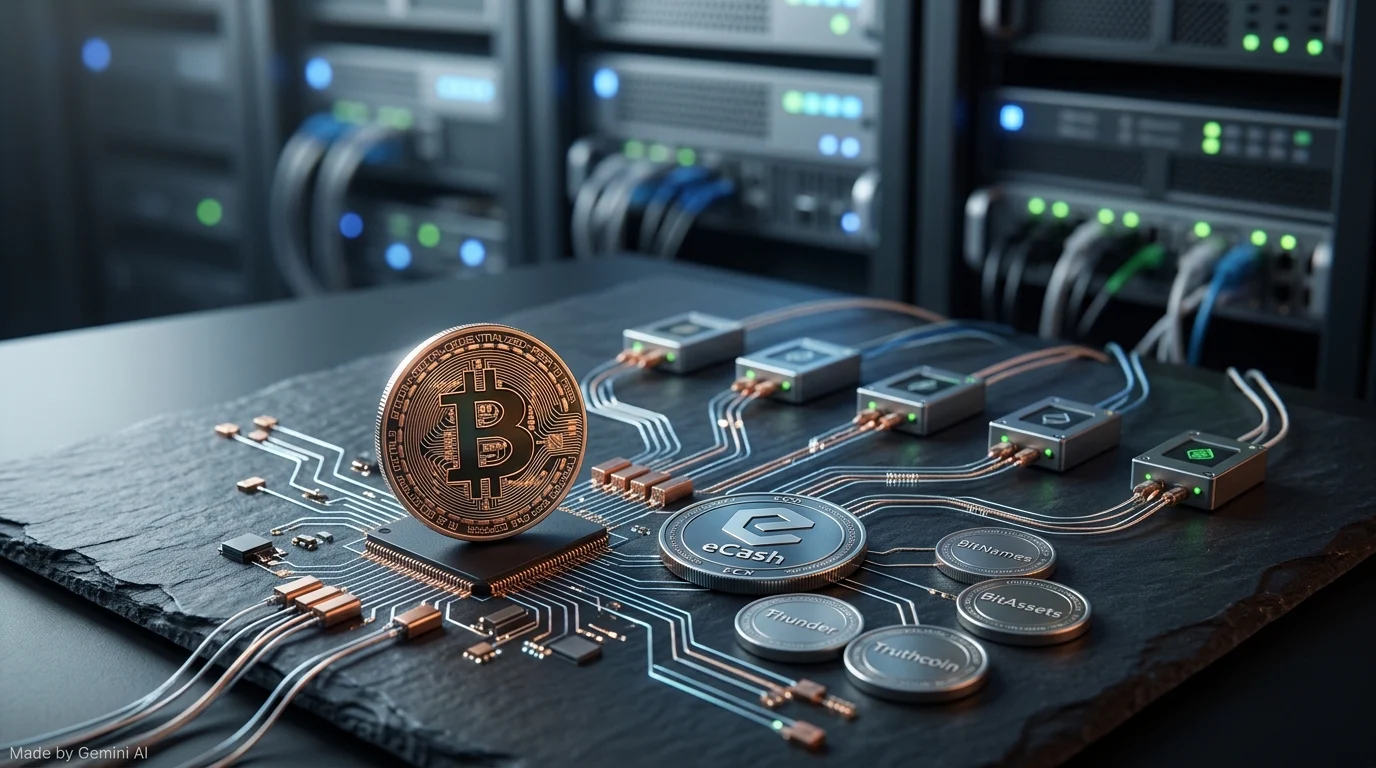
Five sidechains are live immediately: BitNames (identity), BitAssets (digital assets), Thunder (faster payments), Truthcoin (prediction markets) and zSide (privacy-focused transactions). Two further networks are in active development: Photon, which the company describes as quantum-resistant, and CoinShift, a decentralised exchange. All Bitcoin holders at the fork snapshot receive ECX at a 1:1 ratio; self-custody users can separate their BTC and ECX holdings using coin-splitting tools in the eCash mobile wallet.
Bitcoin’s base-layer design prioritises security and decentralisation over programmability. That constraint has historically pushed scaling experiments, smart contracts, privacy protocols and prediction markets onto other chains, most notably Ethereum and its layer-2 ecosystem. Drivechains propose a different approach: sidechains that inherit Bitcoin’s proof-of-work security through merged mining, while running their own rule sets independently of the main chain. Assets can move between the eCash mainchain and its sidechains, creating a modular architecture without requiring consensus changes to Bitcoin Core itself.
Paul Sztorc, chief executive of LayerTwo Labs and the original author of the BIP 300/301 proposals, framed the launch in structural terms. “eCash provides the competitive testing ground necessary to safely drive financial infrastructure forward without risking the core network,” he said. “After ten years of development, we are finally unlocking a free market, where builders can experiment without permission, users can choose which innovations have value, and the market decides what succeeds.”
The mainnet follows phased alpha and beta testing periods during which community participants drove network activity. 44 PH/s across seven independent mining pools, a level that suggests at least initial miner interest, though it remains well below Bitcoin’s current network hashrate.
Source link