

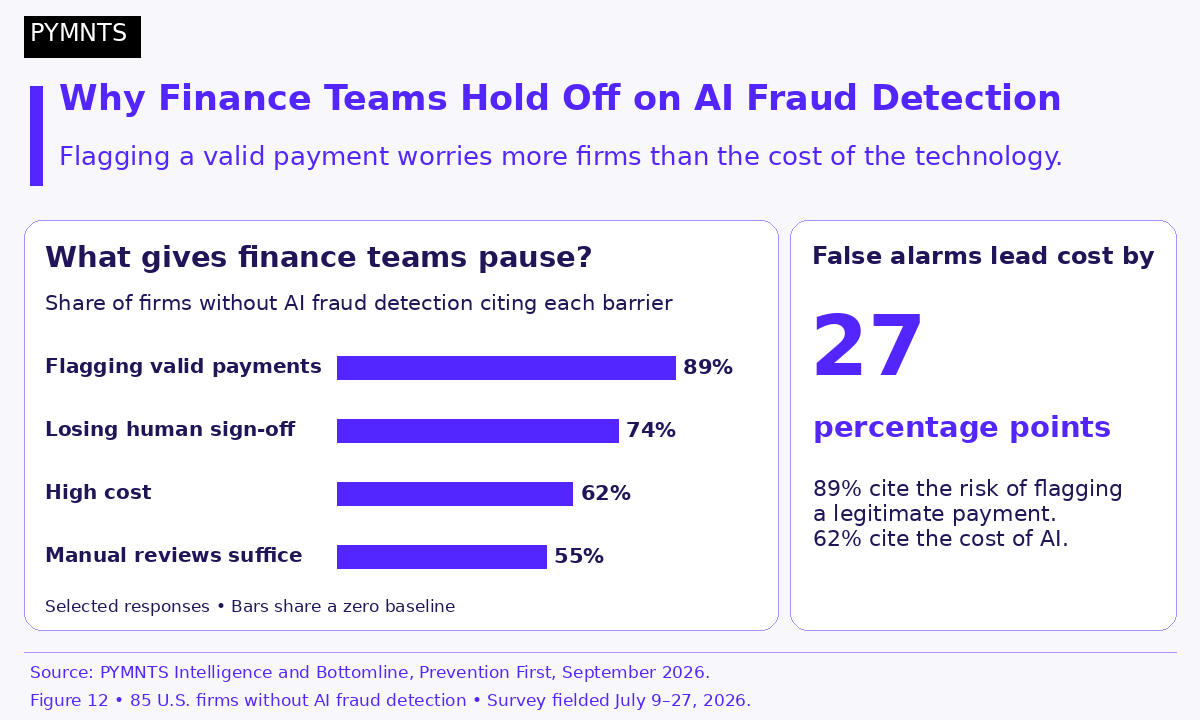
For finance teams weighing whether to use artificial intelligence to spot payment fraud, one of the biggest worries is what happens when a supplier sends a bill that’s perfectly legitimate.
Complete the form to unlock this article and enjoy unlimited free access to all PYMNTS content — no additional logins required.
That concern came through in “Prevention First: Building a Smarter Defense Against Payments Fraud,” a September PYMNTS Intelligence report produced in collaboration with Bottomline. Researchers surveyed 150 treasury and finance executives in the United States at companies with at least $100 million in annual revenue. It found that 57% of firms didn’t use AI to detect fraud in outgoing payments. Many of these firms trust employees to catch suspicious requests. They also see room for software that can help staff check a payment before money leaves the business.
Those tools would join a payment process that already involves several checks. Across the full survey, 83% of firms used bank account validation to detect fraud, 79% required approval from two or more people and 77% used staff reviews. For a finance team that knows its suppliers well, that gives AI a specific job to do. It can draw attention to the payment that deserves a closer look while leaving the decision with the people responsible for sending it.
For all PYMNTS AI coverage, subscribe to the daily AI newsletter.
At PYMNTS Intelligence, we work with businesses to uncover insights that fuel intelligent, data-driven discussions on changing customer expectations, a more connected economy and the strategic shifts necessary to achieve outcomes.
Source link





