
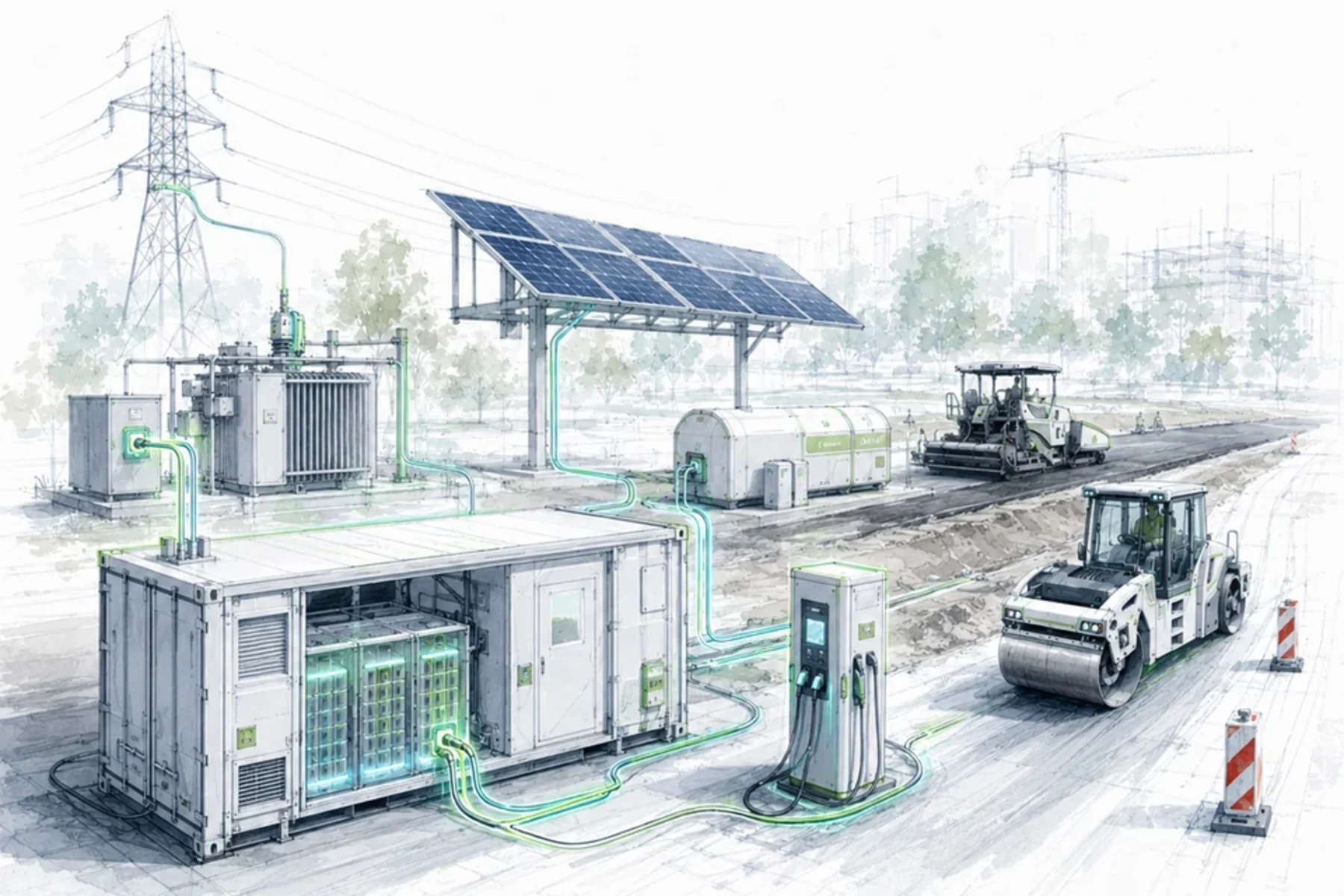
The Volta Via research project has investigated how large construction sites in road building can be electrified and what energy infrastructure is required. Electrified models are already available for up to 86 per cent of the machine classes considered.
The project was conducted by Zeppelin Rental in collaboration with the Chair of Production Engineering of E-Mobility Components (PEM) at RWTH Aachen. Participants included, among others, Autobahn GmbH, the Federal Highway Research Institute (BASt), the Austrian ASFINAG, and the Swiss Federal Roads Office (ASTRA).
The study examined major renovations and surface repairs of asphalt and concrete roadways, among other aspects. For the years 2027, 2040, and 2050, the project partners developed reference scenarios for machinery requirements, energy supply, and charging infrastructure. According to the final report, these must be adapted to construction methods, machinery configurations, construction time, and local conditions.
The results show that electrified models are already commercially available for up to 86 per cent of the required machinery classes. However, this does not imply full technical equivalence with diesel machines. Limitations remain, particularly in continuous power output, operating duration, charging requirements, and deployment flexibility. The authors identify supply gaps primarily in feeders and slipform pavers.
A model calculation for the electrification of motorway renovations illustrates the potential additional electricity demand. 0066 per cent of the country’s total electricity consumption. For the entire D-A-CH region, Volta Via calculates around 44 GWh annually.
Source link