

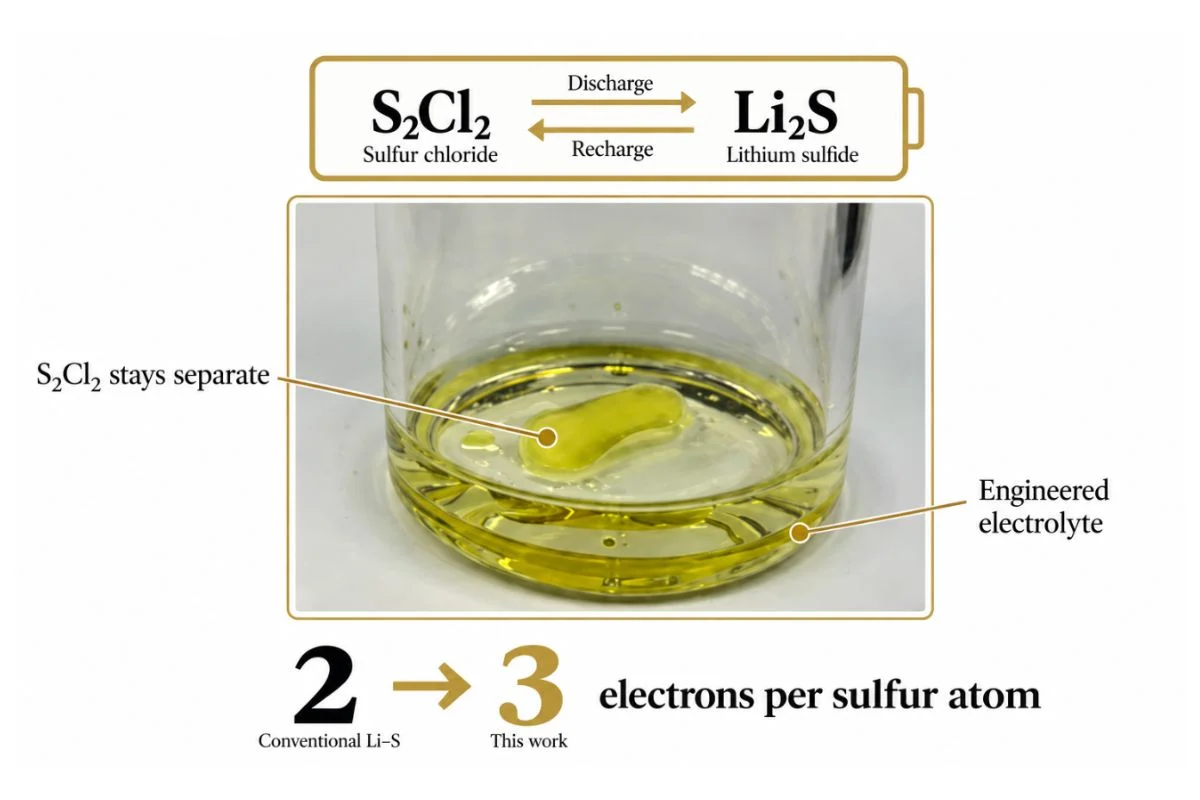
Researchers from Vanderbilt University and the University of Maryland have presented a new cell chemistry that could significantly increase the energy density of lithium-sulphur batteries. By integrating chlorine, the approach enables additional electron transfer at higher voltage.
Lithium-sulphur batteries have long been regarded as a promising alternative to conventional lithium-ion cells, as sulphur is abundant and can store significantly more charge per unit of weight. However, implementing them in a durable and practical way has proven challenging.
In a study published under Nature Energy, a joint team from Vanderbilt University and the University of Maryland describe a new approach in which sulphur participates in an additional energy-storing reaction. The result is a sulphur-based battery that operates at a higher average voltage and stores more charge.
While in conventional systems each sulphur atom exchanges two electrons, the novel system also integrates chlorine to transfer a third electron. In laboratory tests, this increased sulphur’s storage capacity by approximately 58 per cent and raised the average operating voltage from about 2.05 volts to 2.54 volts. By combining enhanced charge storage capacity with higher voltage, one kilogram of sulphur in the experimental test cell was able to store more than 1,700 watt-hours of energy.
To ensure reversibility, the researchers used molecular simulations to design an electrolyte. This keeps the chlorine reactive while simultaneously preventing the resulting sulphur-chlorine product from dissolving and migrating to the lithium-metal anode.
Various spectroscopic techniques confirmed that sulphur repeatedly transitions through the new state during charging and discharging. A constructed pouch cell retained 78 per cent of its initial capacity after 100 charge cycles.
Source link