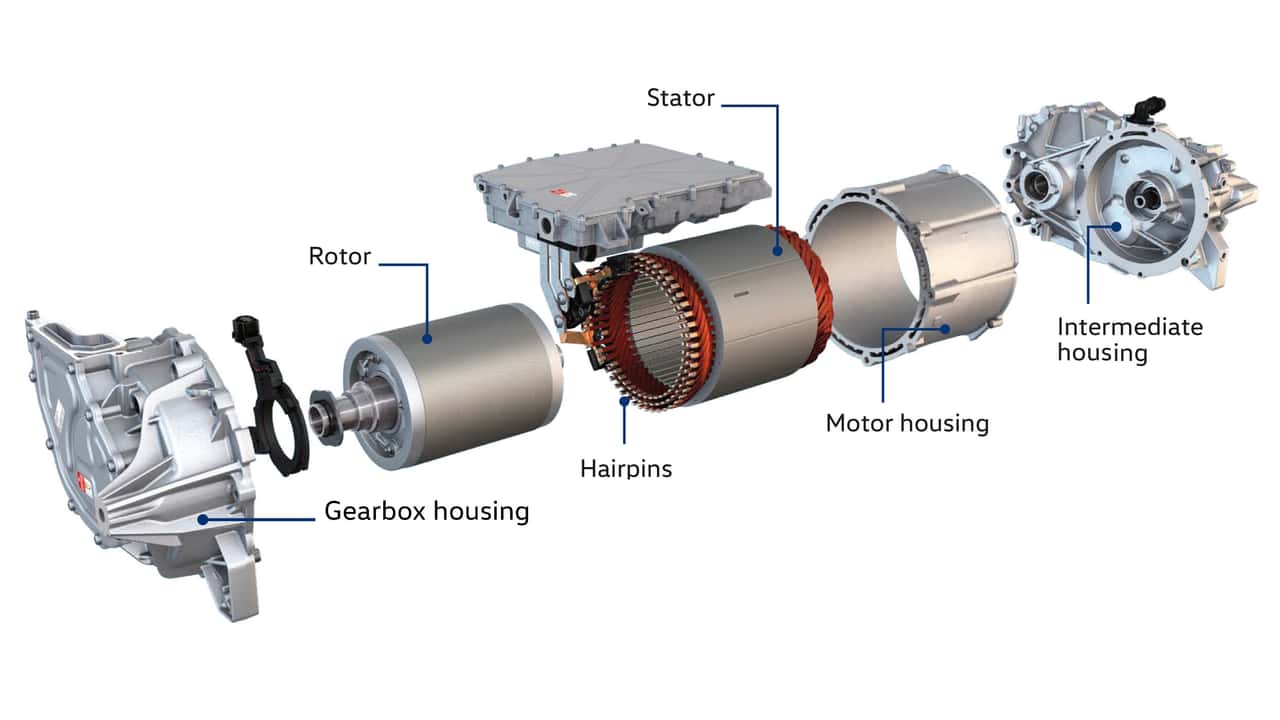
Electric motors don’t get nearly as much attention as batteries, but they're just as interesting and important. There’s a lot more going on inside them than “electricity goes in, rotor spins, wheels turn.” Automakers use different designs—sometimes on the same vehicle—to balance efficiency, performance, packaging, and cost.
The biggest difference is surprisingly easy to understand: where the rotor (the spinning part) gets its magnetism. Some motors have permanent magnets, while others create that magnetic field using electricity. They all use magnetism, but they generate and use it differently.
An EV motor has two main parts: a stationary outer section called the stator and a rotating inner section called the rotor. The rotor is connected to a shaft that sends power to the wheels through reduction gearing, and it needs direct current (DC) from the battery.
An inverter converts that into controlled alternating current (AC), feeding the stator’s coils in a sequence that creates a rotating magnetic field. Try to picture the magnetic pull moving around a circle and the rotor following it.
The term ‘synchronous’ refers to a motor whose rotor spins at the same speed as that magnetic field. Permanent-magnet and electrically excited motors are in the synchronous motor category. Induction motors work with a speed difference between the stator and rotor.
In a permanent-magnet synchronous motor (PMSM), magnets attached to or embedded in the rotor provide the magnetic field. It's the stator’s rotating magnetic field that pulls the rotor around.
Source link