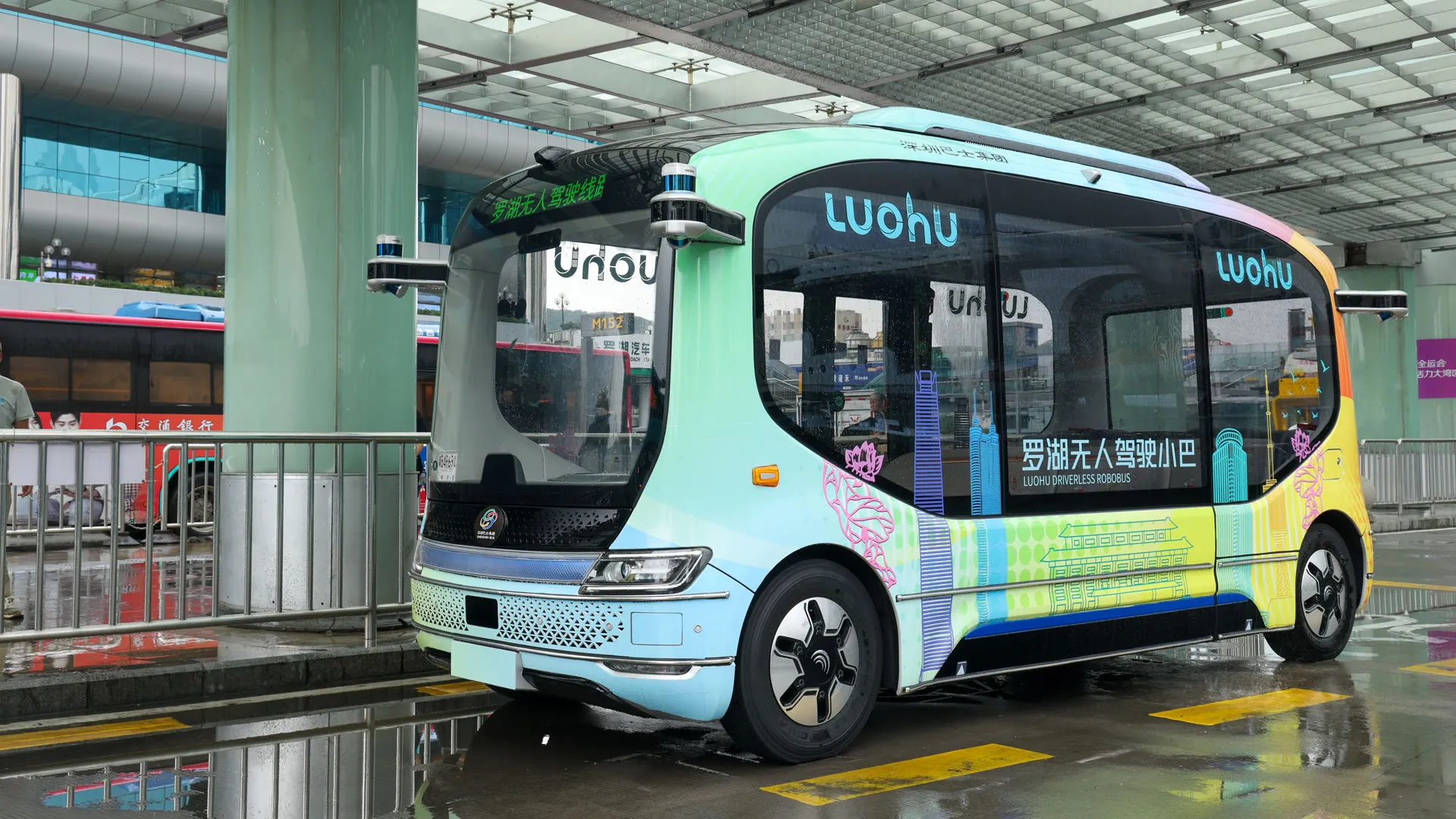
China’s purpose-built urban “smart city” laboratory, Xiong’an, has now received its latest toy: autonomous minibuses. Entering demonstration service in August 2026, the vehicles have since carried passengers on around 6,800 sightseeing journeys while also increasing traffic capacity by 20 percent.
According to reports, the minibuses completed around 12,400 miles (20,000 km) of autonomous testing before going into service. Their routes have eight stops, with buses running at 20-minute intervals.
It is not clear who the supplier of the buses is, but they are visually similar to China’s WeRide fully-electric Robobus. The buses are operated by Xiong’an Group Infrastructure Construction Company Limited and are confirmed as being SAE Level 4 in terms of autonomous driving capability.
While driverless buses like these are not new, what is noteworthy is the seamless integration of “intelligent” vehicles into an underlying, digitally integrated city-wide network. This differs from attempting to “train” vehicles to navigate existing “unintelligent” cities like, say, Beijing or New York.
Conventional autonomous vehicles tend to rely, primarily, on their own onboard equipment to understand their surroundings. This could include things like LiDAR to map physical objects or radar to detect distances and relative speeds.
Vehicles will also feature cameras to identify pedestrians, vehicles, and road markings. At all times, onboard computers will then process information and make driving decisions.
All well and good, but the problem is that these vehicles are effectively only as good as the sensors they use. Buildings, other vehicles, and physical obstructions can obscure hazards.
Xiong’an , on the other hand, is developing an additional layer of intelligence through roadside infrastructure.
Source link