
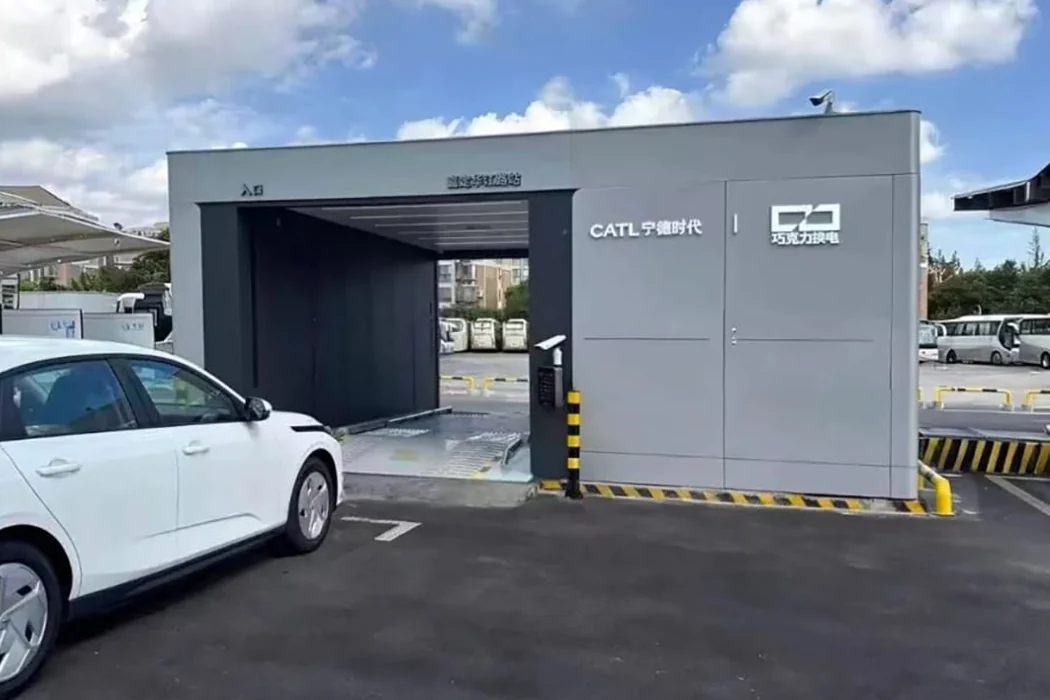
CATL could become the largest battery swap station operator for passenger cars in China next year. The company plans to have 6,000 stations in operation by 2027. According to Chinese industry portals, this should be enough to overtake Nio’s slower-growing battery swapping network.
CATL recently outlined its plans for the battery swapping business in an announcement, as reported by the portal CN EV Post, among others. According to this, the Chinese battery giant aims to expand its so-called ‘Choco’ swapping network for passenger cars to 297 cities by 2027. Specifically, the plan envisages 5,000 battery swapping stations in cities and a further 1,000 along motorways by that year.
CATL now applies the swapping approach to passenger cars, vans and trucks, offering different sizes of standardised swappable batteries at its stations, referred to as ‘Choco-SEB’. SEB stands for ‘Swapping Electric Blocks’, and the term ‘Choco’ is meant to evoke the appearance of a chocolate bar with its individual blocks.
However, the current plans focus solely on passenger car-compatible swapping stations and the corresponding battery blocks. This also invites comparison with Nio, currently the largest operator of a battery swapping system in China. “If CATL meets its 6,000-station target and Nio maintains its goal of adding about 1,000 stations annually, as it has in recent years, CATL’s passenger car battery swap station count could surpass Nio’s in 2027,” analyse the authors of CN EV Post. Nio currently operates 4,254 passenger car battery swapping stations, including 1,081 along motorways.
Regarding CATL’s expansion plans, the new motorway swapping stations are set to cover eleven north-south and nine east-west routes.
Source link