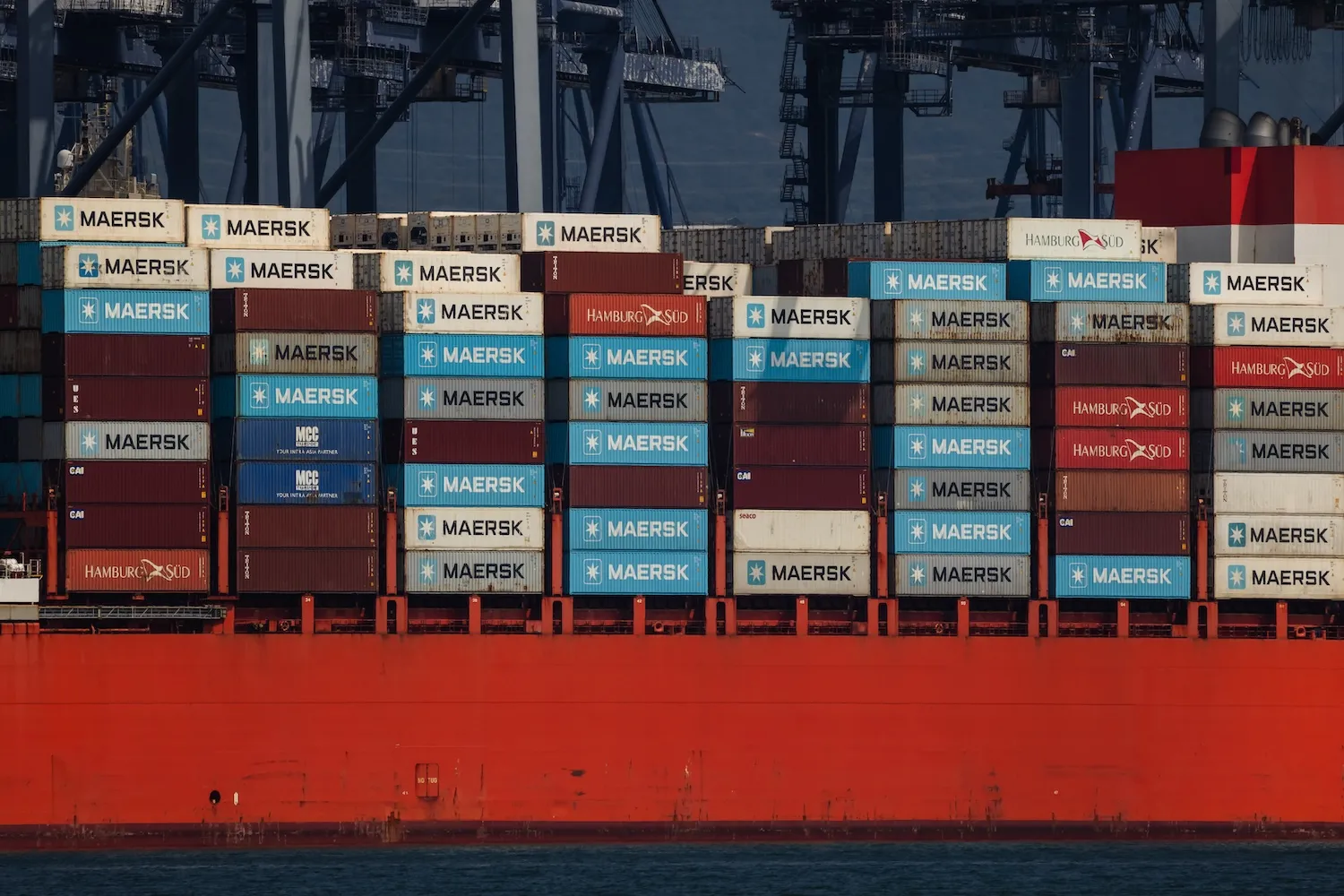
Maersk raised its full-year guidance for the third time this year amid soaring freight rates exacerbated by heavy port congestion since the summer.
For 2026, underlying forecasts for earnings before interest and taxes (EBIT) now sit at $8 billion to $8.5 billion, up substantially from the $4.5 billion to $6.5 billion guide made in August. Underlying EBITDA also benefited, now expected at $14.0 billion to $14.5 billion.
Container demand had weakened for the ocean carrier giant in the third quarter, with Maersk seeing a 0.8 percent decrease in transported volumes to 3.4 million 40-foot equivalent units due to the ongoing congestion at Asian ports.
Related Stories

Kontoor Lifts 2026 Guidance, Sharpens Focus on Wrangler Growth
Trans-Pacific Air Cargo Soars Again, But Capacity is Running Thinner
However, Maersk’s volume on the oceans appears to have underperformed its own industry estimate. The company said global container demand grew between 2 percent and 4 percent from the year prior.
Comparatively, Maersk’s volume lagged behind Cosco Shipping’s 4.5 percent cargo volume growth, as well as Ocean Network Express’s (ONE) 2.2 percent increase in containers moved.
Conversely, Maersk’s average ocean rates rose 46 percent to $3,287 per 40-foot container. The container shipping firm capitalized on an elevated freight-rate environment more efficiently than its rivals, with average rates per 20-foot equivalent unit (TEU) jumping 36.5 percent to $1,709 on average at ONE. Revenue per container increased 25.3 percent to $1,394 per TEU on average at Cosco Shipping.
Maersk CEO Vincent Clerc tied that pricing power to resilient demand meeting capacity that was effectively smaller than the nominal fleet, with strong Far East exports and imports into Africa, Latin America and North America running into the congestion.
Source link