New research suggests that, despite all the hype around agentic shopping, there is still a significant gap between what AI-powered shopping assistants promise and what they actually deliver.
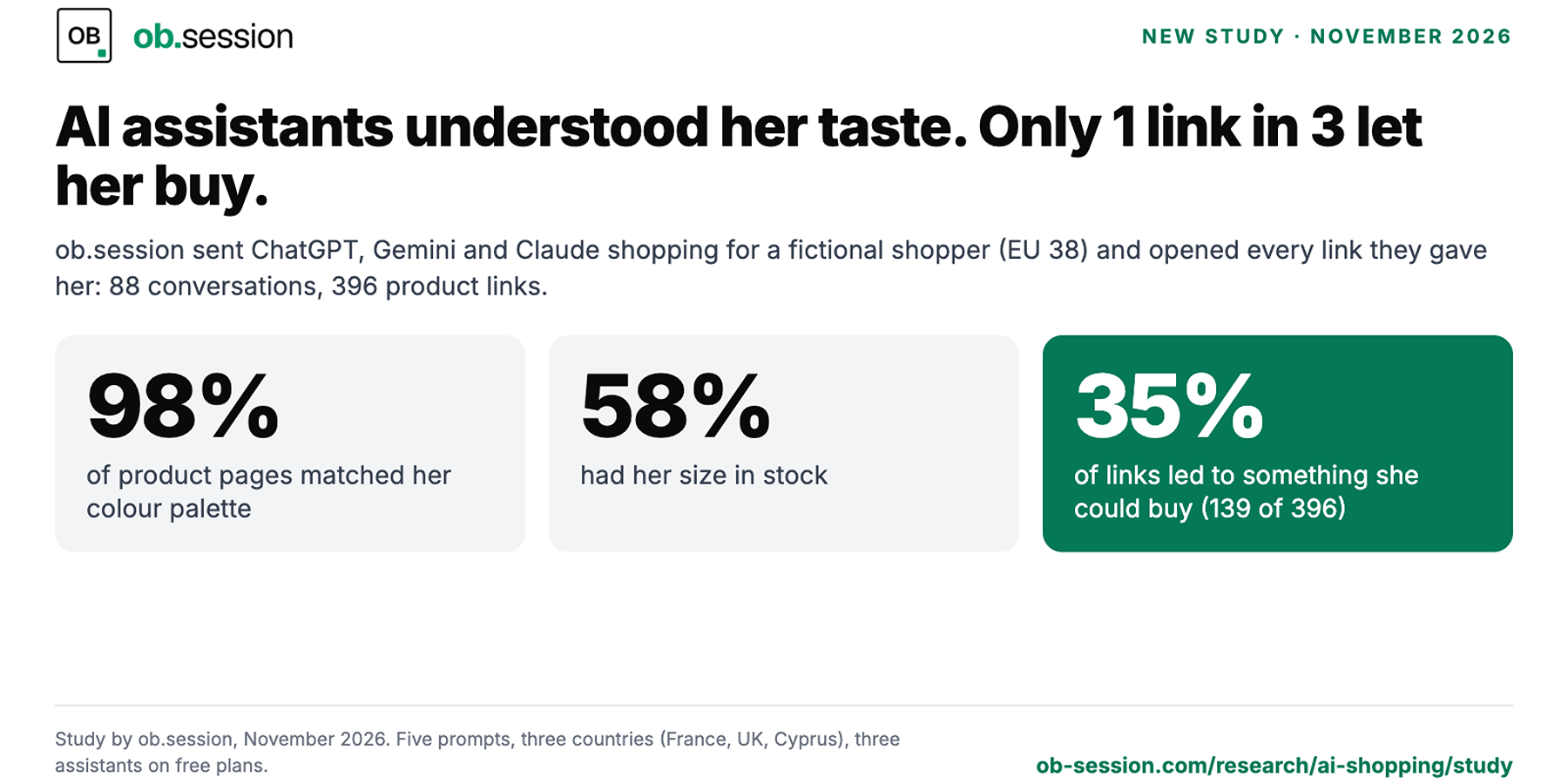
ob.session, a real-time product recommendation engine for Shopify stores, sent ChatGPT, Gemini and Claude shopping on behalf of a fictional customer, Laura, a UK size 10 shopper based variously in France, the UK and Cyprus. Every product link recommended by the large language models (LLMs) was opened and checked against her size, shopping brief and location.
The results were sobering. Across more than 400 product links tested, the LLMs’ recommendations were only in stock 35% of the time, meaning that in nearly two-thirds of cases the suggested item was unavailable.
Of the three models tested, ChatGPT was the most effective at providing usable recommendations, successfully delivering Laura’s chosen item in the correct size and location 45% of the time. Gemini achieved a success rate of 33%, while Claude managed 21%.
The main cause of failure was simple availability. In 29% of cases, the retailer had sold out of Laura’s size, preventing the recommendation from being fulfilled even when the product itself was still listed.
For ecommerce retailers hoping AI shopping agents will become a powerful new sales channel, the findings highlight a significant challenge. If agents cannot reliably surface products that are actually available, retailers risk damaging trust and customer loyalty before transactions even begin.
session, said: “When the information an LLM relies on is outdated, contradicts itself, or doesn’t clearly show availability, trust is lost on two sides: firstly, retailers lose trust as merchants.
Source link