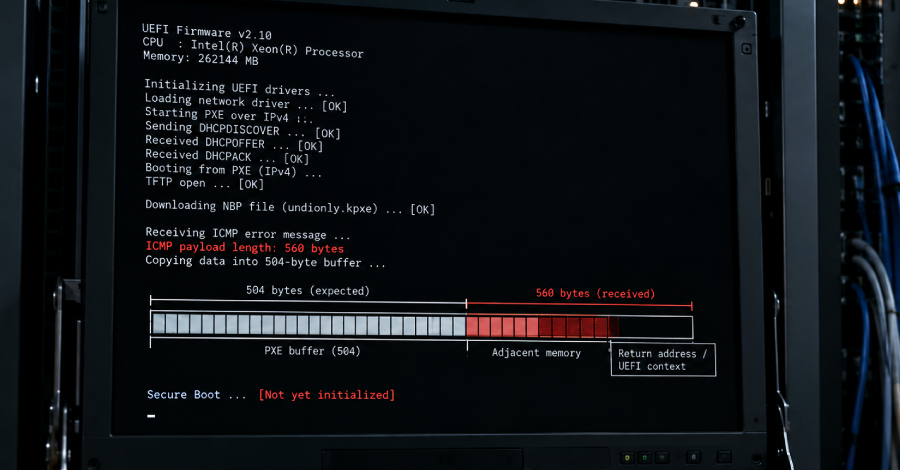
A critical 16-year-old flaw in EDK II, the open-source code that most hardware makers use to build UEFI firmware, can allow an attacker to run code on a machine before its operating system loads, but only while the machine is booting over the network.
UEFI firmware is the software that runs first when a computer is switched on, before the operating system. An attacker who can reach the machine with a crafted network message during such a network boot can hang the boot, or, with work tailored to the exact firmware build, run their own code before Secure Boot and other startup defenses load.
An attacker needs no password and no existing access to the machine, but does need to reach it over the network during the short window when it is booting this way.
Red Hat and SUSE, which both ship the affected code, rated the flaw as one an attacker exploits from an adjacent network position rather than across the open internet.
TianoCore, the project behind EDK II, published an advisory on October 22 and rated the flaw, tracked as CVE-2026-97631, 9.5 out of 10. A code fix exists, but no stable release of EDK II contains it yet, and the advisory still lists no patched version, so most users have nothing to install today.
The flaw is a buffer overflow in EDK II's network-boot code, known as PXE. During a PXE boot, a machine loads its startup image from the network instead of from a local disk.
Source link